Loan Payment Formula: Amortization, APR, and Total Cost Explained
Learn how loan payments are calculated, how amortization changes principal and interest over time, and how APR, term length, and extra payments affect total cost.
A loan payment can look simple on the surface: borrow money, make the same payment each month, and eventually the balance reaches zero. The math underneath is more interesting. Every payment is split between interest and principal, and that split changes each month. This process is called amortization. Understanding it helps you compare loan offers, test extra payment plans, and avoid the trap of judging a loan only by the monthly payment.
This guide explains the monthly payment formula, the amortization schedule, the difference between interest rate and APR, and the practical checks to make before relying on a loan estimate. You can use the loan payment calculator alongside the examples to verify the numbers instantly.
The Loan Payment Formula
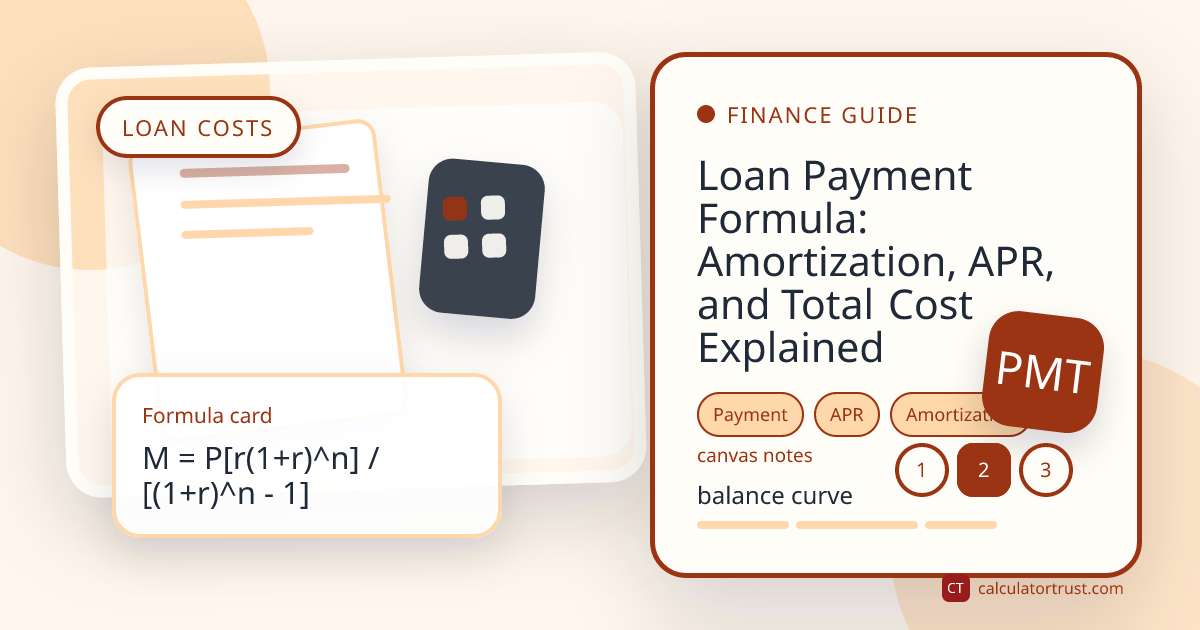
Most fixed-rate installment loans use the same amortized payment formula:
M = P[r(1+r)^n] / [(1+r)^n - 1]
Where:
Formula Snapshot
The core equation and the variables that control the answer.
- M is the monthly payment.
- P is the loan principal, or amount borrowed.
- r is the monthly interest rate as a decimal.
- n is the total number of monthly payments.
The most common mistake is mixing annual and monthly units. If the annual interest rate is 7.2%, the monthly rate used in the formula is 0.072 / 12 = 0.006. If the loan term is five years, the number of monthly payments is 5 x 12 = 60. The rate and period must match.
Worked Example: A Five-Year Personal Loan
Suppose you borrow $18,000 at a 7.2% annual interest rate for five years. The inputs are:
- Principal: $18,000
- Annual interest rate: 7.2%
- Monthly interest rate: 0.006
- Number of payments: 60
Input Checklist
The values to collect before trusting the calculation.
Using the formula, the estimated monthly payment is about $358.16. Over 60 months, total payments are $21,489.60, so total interest is about $3,489.60. The payment tells you the monthly commitment. The total interest tells you the long-term cost of borrowing.
Why the First Payment Is Mostly Interest
The first month starts with the full $18,000 balance. Interest for that month is $18,000 x 0.006 = $108. If the payment is $358.16, then $108 goes to interest and $250.16 reduces the principal. After that payment, the balance is about $17,749.84.
In the next month, interest is calculated on $17,749.84 instead of $18,000. The interest portion is slightly lower, so a little more of the fixed payment goes to principal. That is the basic rhythm of amortization.
What an Amortization Schedule Shows
An amortization schedule is a month-by-month table showing payment, interest, principal, and remaining balance. It is useful because two loans can have similar payments but very different interest costs over time.
Worked Example Flow
A step-by-step flow for checking the math against real numbers.
Early, Middle, and Late Loan Behavior
Early in the loan, the interest portion is largest because the balance is largest. In the middle, principal reduction starts to accelerate. Near the end, almost the entire payment goes to principal because the remaining balance is small. This is why extra payments made early usually save more interest than the same extra payments made late.
Reading the Schedule Without Getting Lost
Focus on three columns first: remaining balance, interest paid that month, and total interest paid so far. Those three columns show whether the loan is shrinking quickly enough for your goal. The payment column alone does not reveal that.
Real-World Scenario
How the calculation changes when real-life assumptions are included.
APR vs Interest Rate
The interest rate is the rate used to calculate interest on the balance. APR, or annual percentage rate, is intended to represent the yearly cost of borrowing after certain fees are included. APR is especially useful when comparing offers from different lenders because one lender may advertise a lower rate but charge higher required fees.
APR does not mean every fee is automatically included in your monthly payment. It is a comparison metric. For cash-flow planning, look at the actual payment, required fees, insurance, taxes if applicable, and any prepayment rules.
How Term Length Changes the Payment
Extending a loan term usually lowers the monthly payment, but it often increases total interest. Shortening the term raises the payment but can reduce the amount paid to the lender over the life of the loan.
Imagine the same $18,000 loan at 7.2%. A 36-month term has a higher monthly payment than a 60-month term, but the loan is exposed to interest for fewer months. A 72-month term lowers the payment again, but the longer runway gives interest more time to accumulate.
Comparison Map
A visual way to compare options, ranges, or outcomes.
Payment Comfort vs Total Cost
The best loan is not always the shortest loan. A very high payment can create cash-flow stress, missed payments, or expensive borrowing somewhere else. A responsible comparison balances monthly affordability with total cost, emergency savings, and payoff flexibility.
Variable Rates and Payment Risk
The formula above assumes a fixed rate. Some loans have variable rates, promotional rates, or rate resets. Those loans require extra caution because today's payment may not be the payment you keep. A variable-rate loan can be affordable at the starting rate and stressful after the rate adjusts.
If a loan can reset, ask for the adjustment rules. How often can the rate change? Is there a maximum rate? Is there a maximum payment increase? What index controls the change? A calculator can model a fixed-rate estimate, but the contract controls what happens when the rate moves.
Mistake Checklist
Common errors that can make a correct formula produce a misleading result.
Stress-Test the Payment
A simple stress test is to run the same principal and term at a higher rate. If the loan is comfortable at 7% but impossible at 9%, that risk deserves attention. This does not mean every borrower must avoid variable rates. It means the decision should include the payment that could happen, not just the payment advertised today.
Extra Payments and Principal Reduction
Extra payments can reduce interest when they are applied to principal. For example, adding $50 per month to the five-year loan above lowers the balance faster. The exact savings depend on when the extra payments start, the rate, and whether the lender applies the extra amount correctly.
Before setting up extra payments, check three details:
Quality Check
Simple checks for spotting a result that looks too high, low, or incomplete.
- Does the lender apply extra money to principal automatically?
- Is there a prepayment penalty?
- Does the extra payment change the next due date or only reduce balance?
If the lender advances your due date instead of reducing principal, the savings may be much smaller than expected. Read the payment instructions carefully.
Common Loan Payment Mistakes
- Comparing only the monthly payment. A smaller payment can hide a much larger total cost.
- Ignoring fees. Origination fees, documentation fees, and required add-ons can change the real cost.
- Using the annual rate as the monthly rate. Always divide an annual rate by 12 for monthly calculations.
- Assuming every loan amortizes normally. Some loans include balloon payments, deferred interest, or variable rates.
- Forgetting taxes or insurance on secured loans. A mortgage or auto loan may require more than principal and interest.
How to Compare Two Loan Offers
Build a small comparison table before choosing. Include the interest rate, APR, term, payment, upfront fees, total interest, total amount paid, prepayment rules, and late-fee policy. A loan with a slightly higher payment may be cheaper if it has fewer fees or a shorter payoff period.
Quick Reference
A compact checklist for using the guide and calculator together.
If two offers are close, test a realistic stress case. What happens if income drops for one month? What happens if you pay $50 extra? What happens if you refinance or pay off early? A good loan should work under more than one perfect-case scenario.
When to Use a Calculator
Manual math is useful because it teaches the structure. A calculator is useful because it lets you compare many scenarios quickly. Use the loan payment calculator to test rate, term, principal, and payment changes. Then use the amortization logic from this guide to interpret the result instead of treating the monthly payment as the whole story.
This article is educational and does not replace financial advice. For large or legally binding borrowing decisions, review the lender documents and consider speaking with a qualified professional.