Finance Calculator
Compound Interest Calculator
Calculate how much your money will grow over time with compound interest.
Financial estimate notice
Finance calculator results are educational estimates and are not financial advice. Verify rates, fees, taxes, and assumptions with a qualified professional.
Enter Values
Calculator loading
The guide, formula, examples, and FAQ are available below.
How to Use This Calculator
Enter Initial Investment ($)
Type your initial investment ($) into the input field. For example: e.g., 10000. Minimum value: 0.
Enter Annual Interest Rate (%)
Type your annual interest rate (%) into the input field. For example: e.g., 5. Minimum value: 0.
Enter Years to Grow
Type your years to grow into the input field. For example: e.g., 10. Minimum value: 1.
Enter Compounding Frequency (per year)
Type your compounding frequency (per year) into the input field. For example: e.g., 12 for monthly. Minimum value: 1.
View Your Result
The result appears beside the calculator with the main answer and a detailed calculation breakdown.
Adjust and Explore
Change any input value and calculate again. Use the copy and share controls to save or send your result.
On this page
Formula
A = the future value of the investment/loan, including interest. P = the principal investment amount. r = the annual interest rate (decimal). n = the number of times that interest is compounded per unit t. t = the time the money is invested or borrowed for.
Finance calculation note
Finance calculators use standard time-value-of-money and amortization formulas for education and planning.
Rates, fees, taxes, inflation, and investment returns can change. Verify assumptions before making financial decisions.
Source and review references
Last reviewed by the Calculator Trust Editorial Team. To report an issue, email contact [at] calculatortrust.com.
Common Examples
Understanding the Concept
Compound interest is the addition of interest to the principal sum of a loan or deposit, or in other words, interest on interest. It is the result of reinvesting interest, rather than paying it out, so that interest in the next period is then earned on the principal sum plus previously accumulated interest.
The Power of Compounding
Albert Einstein famously called compound interest the "eighth wonder of the world." The reason is that over long periods of time, the interest earned on the interest begins to snowball, leading to exponential growth of your initial investment. The earlier you start investing, the more time compounding has to work its magic.
The Rule of 72: A Quick Mental Shortcut
The Rule of 72 is one of the most practical shortcuts in personal finance. To estimate how many years it takes to double your money, simply divide 72 by your annual interest rate. At 6% annual returns, your money doubles in roughly 12 years. At 8%, it takes about 9 years. At 12%, just 6 years.
This rule works surprisingly well for rates between 2% and 15%. Beyond that range, it starts to lose accuracy, but for typical savings and investment scenarios it is remarkably precise. The Rule of 72 also works in reverse: if you want to double your money in 5 years, you need a return of roughly 72 / 5 = 14.4% annually.
Understanding this shortcut makes it easy to compare investment options on the fly. If a savings account offers 4.5% and a bond fund offers 6%, you can quickly see that the bond fund doubles your money in 12 years versus 16 years for the savings account. That 4-year difference compounds into a massive gap over a 30-year investing career.
Compounding Frequency: Why It Matters
How often interest compounds can make a meaningful difference in your returns. A 5% annual rate compounded annually on $10,000 yields $16,288.95 after 10 years. The same rate compounded monthly yields $16,470.09 -- an extra $181.14 from nothing more than more frequent compounding.
Here is how the same $10,000 at 5% grows over 10 years under different compounding schedules:
- Annually (1x/year): $16,288.95
- Quarterly (4x/year): $16,436.19
- Monthly (12x/year): $16,470.09
- Daily (365x/year): $16,486.65
- Continuously: $16,487.21
Notice that the jump from annual to monthly compounding is much larger than from monthly to daily. In practice, monthly compounding captures most of the benefit. Some high-yield savings accounts and money market funds compound daily, but the incremental gain over monthly compounding is minimal. The bigger factor is always the interest rate itself and how long you stay invested.
Real-World Examples of Compound Interest
Compound interest works both for you and against you depending on which side of the transaction you are on. Consider these real-world scenarios:
Retirement savings: A 25-year-old who invests $200 per month at a 7% average annual return will have approximately $528,000 by age 65. Of that total, only $96,000 came from actual contributions. The remaining $432,000 is pure compound interest -- money earned on money. If the same person waits until age 35 to start, they accumulate only about $244,000. That 10-year delay costs nearly $284,000 in lost compounding.
Credit card debt: Compounding works against borrowers just as powerfully. A $5,000 credit card balance at 22% APR, making only minimum payments, takes over 24 years to pay off and costs more than $9,000 in interest alone. The original debt nearly triples because the interest compounds on unpaid interest month after month.
Mortgage interest: On a 30-year, $300,000 mortgage at 6.5%, total interest paid over the life of the loan comes to roughly $382,000 -- more than the house itself. Making one extra mortgage payment per year can shave 4 to 5 years off the loan and save over $60,000 in interest.
History of Compound Interest
The concept of interest on interest dates back thousands of years. Ancient Sumerian clay tablets from around 2400 BCE show evidence of compound interest calculations in grain lending. The Code of Hammurabi, written around 1754 BCE, included regulations limiting interest rates, indicating that compounding was already common enough to require legal oversight.
In medieval Europe, charging interest was widely prohibited by the Catholic Church under usury laws. This drove lending underground and into the hands of communities exempt from those rules. By the Renaissance, Italian merchant banks had developed sophisticated compound interest tables, and the Medici family built one of the largest fortunes in history partly through the intelligent use of compounding.
The mathematical formalization of compound interest came in the 17th century. Jacob Bernoulli discovered the constant e (approximately 2.71828) in 1683 while studying the behavior of compound interest as compounding frequency approaches infinity. This mathematical constant, born from a finance problem, went on to become one of the most important numbers in all of mathematics, appearing in fields from calculus to quantum physics.
Common Mistakes to Avoid
Understanding compound interest is one thing; avoiding common pitfalls is another. Here are mistakes that cost people real money:
- Ignoring fees: A mutual fund charging 1.5% in annual fees versus one charging 0.1% may not sound like a big difference. But over 30 years on a $100,000 investment at 7% gross returns, the high-fee fund costs you roughly $175,000 in lost growth. Fees compound just like interest does, except they compound against you.
- Withdrawing early: Pulling money out of a retirement account interrupts compounding and often triggers tax penalties. Every dollar removed loses not just its face value but all the future growth it would have generated.
- Waiting to start: Many people think they need a large sum to begin investing. In reality, starting with $50 per month at age 22 beats starting with $500 per month at age 40, thanks to the extra compounding years.
- Confusing APR with APY: The annual percentage rate (APR) does not account for compounding. The annual percentage yield (APY) does. A savings account advertising 5.00% APR compounded daily actually yields about 5.13% APY. Always compare APY to APY when evaluating accounts.
Frequently Asked Questions
What is the difference between simple and compound interest?
How does the Rule of 72 work?
What is the best compounding frequency?
How much should I invest to reach $1 million?
Does inflation affect compound interest returns?
What is the difference between APR and APY?
Is compound interest taxed?
Can compound interest work against me?
Learn More
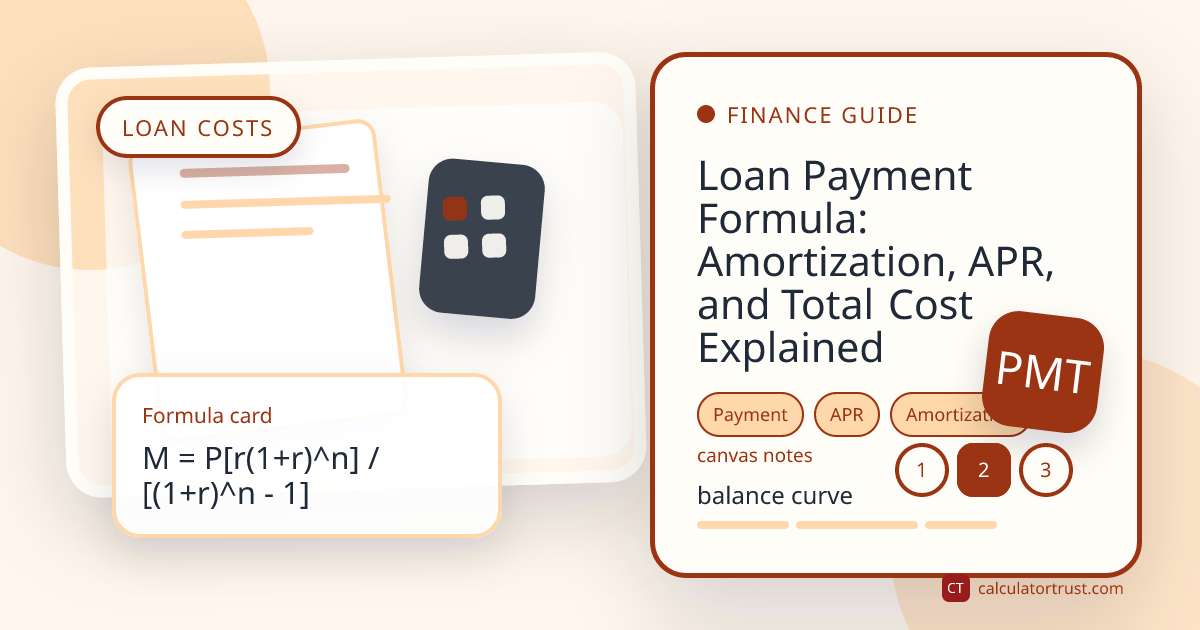
Loan Payment Formula: Amortization, APR, and Total Cost Explained
Learn how loan payments are calculated, how amortization changes principal and interest over time, and how APR, term length, and extra payments affect total cost.
Read Article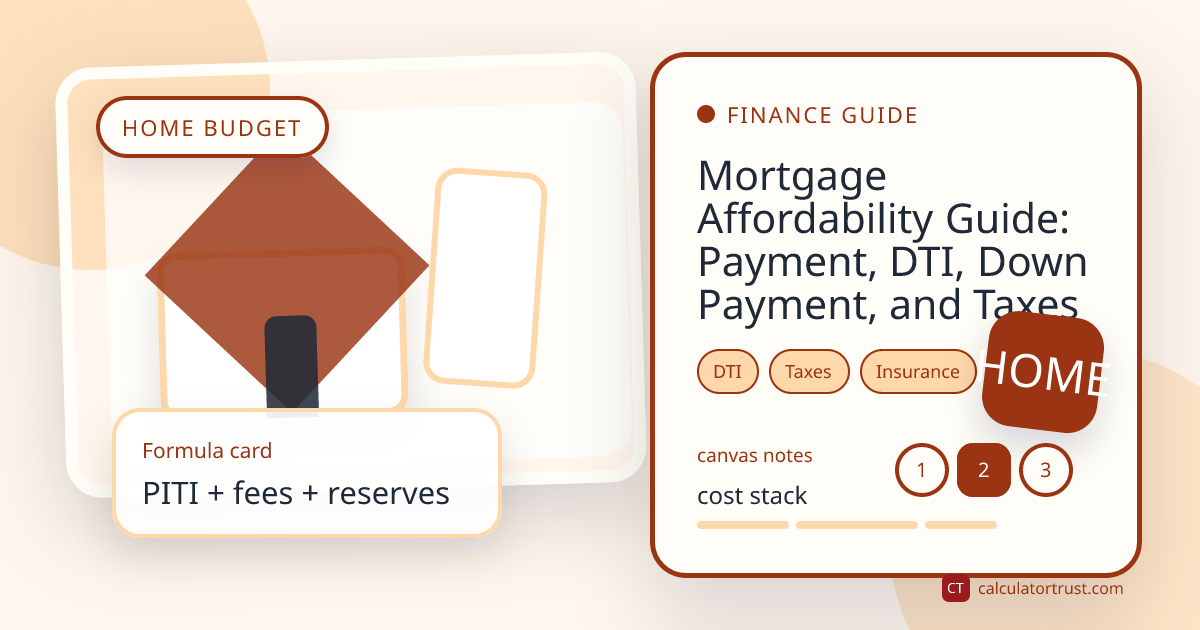
Mortgage Affordability Guide: Payment, DTI, Down Payment, and Taxes
A practical guide to estimating mortgage affordability with principal, interest, taxes, insurance, down payment, debt-to-income ratio, and cash reserves.
Read ArticleWritten and reviewed by Calculator Trust Editorial Team
Our calculators are built using verified formulas from academic, government, and scientific sources. Content is fact-checked and reviewed for accuracy.Note: This calculator provides estimates for educational purposes only. Consult a qualified financial advisor for personalized advice.