Mortgage Affordability Guide: Payment, DTI, Down Payment, and Taxes
A practical guide to estimating mortgage affordability with principal, interest, taxes, insurance, down payment, debt-to-income ratio, and cash reserves.
Mortgage affordability is not just the price of a house divided by a loan term. The real question is whether the full monthly housing cost fits your income, debt, savings, and risk tolerance. A mortgage payment can include principal, interest, property taxes, homeowners insurance, mortgage insurance, HOA fees, and local assessments. Small changes in any of those inputs can move the monthly cost by hundreds of dollars.
This guide explains how to estimate affordability step by step. Use it with the mortgage calculator to test payment scenarios and the rent vs buy calculator to compare ownership against renting.
Start With the Full Monthly Payment
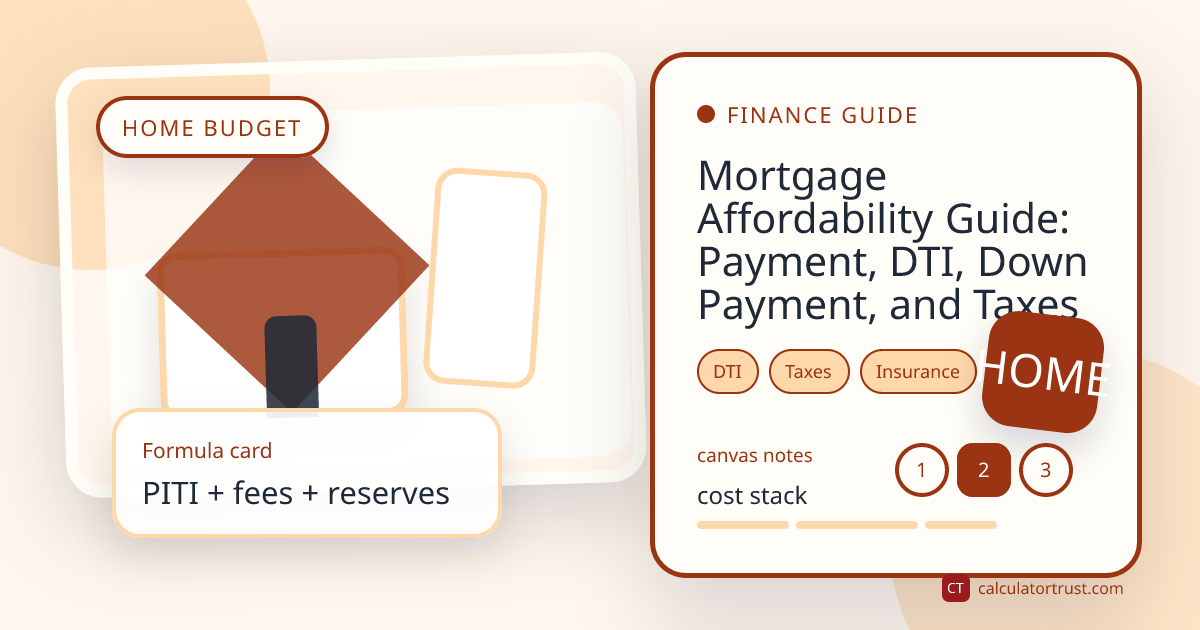
A common mistake is looking only at principal and interest. That number matters, but it is not the whole housing bill. The common shorthand is PITI:
- Principal: the part of the payment that reduces the loan balance.
- Interest: the cost charged by the lender.
- Taxes: property taxes charged by local government.
- Insurance: homeowners insurance and sometimes mortgage insurance.
Many buyers also need to add HOA fees, flood insurance, local assessments, utilities, and maintenance. A home that looks affordable on principal and interest can become tight once those costs are added.
Formula Snapshot
The core equation and the variables that control the answer.
The Principal and Interest Formula
The loan portion of a fixed-rate mortgage uses the same amortization formula as many other installment loans:
M = P[r(1+r)^n] / [(1+r)^n - 1]
Here, P is the loan amount after down payment, r is the monthly interest rate, and n is the number of monthly payments. A 30-year mortgage has 360 monthly payments. A 15-year mortgage has 180. The shorter term usually has a higher monthly payment but much lower total interest.
Worked Example: Same Price, Different Payment
Suppose a home costs $400,000 and the buyer puts 10% down. The loan amount is $360,000. At a 6.5% fixed rate over 30 years, principal and interest are about $2,275 per month. That is not the final affordability number.
Input Checklist
The values to collect before trusting the calculation.
Add estimated ownership costs:
- Property taxes: $450 per month
- Homeowners insurance: $160 per month
- Mortgage insurance: $170 per month
- HOA fee: $90 per month
The full monthly estimate becomes about $3,145. If the buyer only budgeted for the $2,275 loan payment, the real bill is $870 higher than expected.
Debt-to-Income Ratio
Debt-to-income ratio, or DTI, compares monthly debt payments with gross monthly income. It is one way lenders evaluate affordability, and it is also useful for personal planning.
Front-End DTI
Front-end DTI looks at housing costs only. If gross monthly income is $8,500 and estimated housing cost is $3,145, front-end DTI is $3,145 / $8,500 = 37.0%.
Worked Example Flow
A step-by-step flow for checking the math against real numbers.
Back-End DTI
Back-end DTI includes housing plus other monthly debt. If the same buyer has $450 in auto payments, $250 in student loans, and $150 in credit card minimums, total debt is $3,995. Back-end DTI is $3,995 / $8,500 = 47.0%.
Why DTI Is Not the Same as Comfort
DTI uses gross income, not take-home pay. It also does not know your childcare costs, medical needs, savings goals, commuting costs, or income volatility. A loan can pass a DTI screen and still feel uncomfortable in real life.
Down Payment and Cash Needed at Closing
A larger down payment reduces the loan amount and may reduce or remove mortgage insurance. But putting every dollar into the down payment can leave the buyer without enough cash for closing costs, repairs, furniture, moving, and emergencies.
Real-World Scenario
How the calculation changes when real-life assumptions are included.
For planning, separate these buckets:
- Down payment: the amount applied to the purchase price.
- Closing costs: lender, title, escrow, prepaid tax, and insurance items.
- Move-in costs: moving, deposits, appliances, furniture, and setup.
- Reserve fund: money left after closing for surprises.
The safest number is not just "Can I close?" It is "Can I close and still have enough reserves to handle normal homeownership?"
Interest Rate Sensitivity
Mortgage affordability is highly sensitive to interest rates. A one-point rate change on a large loan can shift the payment substantially. This is why preapproval numbers can change when rates move, even if income and home price stay the same.
Comparison Map
A visual way to compare options, ranges, or outcomes.
When comparing homes, test at least three rate scenarios: the quoted rate, a slightly higher rate, and a lower rate. The higher-rate scenario helps you understand whether the purchase still works if the market changes before closing.
Property Taxes and Insurance Are Not Side Notes
Taxes and insurance can vary widely by location and property type. A newer home in one area may have lower maintenance but higher taxes. An older home may have a lower purchase price but higher insurance or repair risk. A coastal or flood-prone area may require additional coverage.
Do not use a generic national average if you can get local estimates. Look up county tax records, ask for insurance quotes, and review HOA documents before relying on a payment estimate.
Maintenance and the Ownership Buffer
Maintenance is not usually part of the mortgage payment, but it is part of affordability. Roofs, HVAC systems, plumbing, appliances, landscaping, and small repairs all cost money. A common planning approach is to reserve a percentage of the home value each year for maintenance, then adjust based on age, condition, and climate.
Mistake Checklist
Common errors that can make a correct formula produce a misleading result.
The point is not to predict every repair. The point is to avoid building a budget that only works when nothing breaks.
Build a Buyer Worksheet
A good affordability estimate is easier to trust when it is written as a worksheet instead of held in your head. Create one row for each monthly cost and one row for each cash item due before or near closing. This prevents the common mistake of mixing monthly payment questions with one-time cash questions.
Monthly Worksheet
- Principal and interest
- Property taxes
- Homeowners insurance
- Mortgage insurance if required
- HOA or condo fee
- Utilities and routine maintenance reserve
Quality Check
Simple checks for spotting a result that looks too high, low, or incomplete.
Cash-to-Close Worksheet
- Down payment
- Closing costs and lender fees
- Prepaid taxes and insurance
- Moving costs
- Immediate repair or furnishing budget
- Emergency reserves left after closing
Keeping the two worksheets separate makes the decision clearer. A buyer may have enough monthly income but not enough cash to close safely, or enough cash to close but not enough monthly flexibility after the move.
Keep a Personal Comfort Line
After the lender estimate is complete, set your own comfort line. This is the payment that still leaves room for savings, repairs, food, transportation, insurance, and normal life. A personal comfort line is often lower than a maximum approval amount, and that is a useful signal rather than a failure.
Rent vs Buy Context
A mortgage payment is only one part of the rent-versus-buy decision. Ownership can build equity, but it also concentrates risk and reduces flexibility. Renting may cost less in the short term or make more sense if you expect to move soon.
Quick Reference
A compact checklist for using the guide and calculator together.
Use the rent vs buy calculator to compare time horizon, rent growth, home appreciation, maintenance, buying costs, and selling costs. A home can be affordable and still not be the best financial choice for a short stay.
Mortgage Affordability Checklist
- Use the full PITI estimate, not principal and interest alone.
- Add HOA fees, mortgage insurance, and local assessments if they apply.
- Compare front-end and back-end DTI.
- Keep cash for closing costs and post-closing reserves.
- Stress-test the payment at a higher interest rate.
- Estimate maintenance and utilities before deciding.
- Compare ownership with renting over your real time horizon.
This guide is educational and should not replace advice from a mortgage professional, tax advisor, attorney, or financial planner. Always verify terms against your actual loan estimate and closing documents.