Health Calculator
Calorie Calculator
Estimate your daily calorie needs based on age, gender, weight, height, and activity level using the Mifflin-St Jeor equation.
Health estimate notice
Health calculator results are educational estimates and are not medical advice. Speak with a qualified healthcare professional before making health decisions.
Enter Values
Calculator loading
The guide, formula, examples, and FAQ are available below.
How to Use This Calculator
Select Gender
Choose the appropriate option from the "Gender" dropdown. Options include: Male, Female.
Enter Age (years)
Type your age (years) into the input field. For example: e.g., 30. Minimum value: 1. Maximum value: 120.
Enter Weight (kg)
Type your weight (kg) into the input field. For example: e.g., 75. Minimum value: 1.
Enter Height (cm)
Type your height (cm) into the input field. For example: e.g., 175. Minimum value: 1.
Select Activity Level
Choose the appropriate option from the "Activity Level" dropdown. Options include: Sedentary (little or no exercise), Lightly Active (1-3 days/week), Moderately Active (3-5 days/week), Active (6-7 days/week), Very Active (intense daily exercise).
View Your Result
The result appears beside the calculator with the main answer and a detailed calculation breakdown.
Adjust and Explore
Change any input value and calculate again. Use the copy and share controls to save or send your result.
On this page
Formula
The Mifflin-St Jeor equation calculates Basal Metabolic Rate (BMR), where W is weight in kg, H is height in cm, and A is age in years. BMR is then multiplied by an activity factor to get Total Daily Energy Expenditure (TDEE).
Health calculation note
Health calculators provide screening or planning estimates, not medical diagnoses.
Results can vary by age, sex, body composition, medical history, medication, and clinician-specific guidance.
Source and review references
Last reviewed by the Calculator Trust Editorial Team. To report an issue, email contact [at] calculatortrust.com.
Common Examples
Understanding the Concept
Knowing how many calories your body needs each day is foundational to managing your weight and overall health. Whether your goal is to lose weight, gain muscle, or simply maintain your current physique, an accurate calorie estimate gives you the information you need to make informed dietary choices. This calculator uses the Mifflin-St Jeor equation, which is widely regarded by nutrition professionals as the most accurate formula for estimating daily caloric needs.
Understanding Basal Metabolic Rate (BMR)
Your Basal Metabolic Rate is the number of calories your body needs to perform basic life-sustaining functions like breathing, circulating blood, regulating body temperature, and maintaining organ function. BMR accounts for roughly 60-75% of your total daily energy expenditure.
Several factors influence your BMR, including your body composition (muscle burns more calories than fat at rest), age (BMR decreases with age), gender (men typically have higher BMRs due to greater muscle mass), and genetics. The Mifflin-St Jeor equation accounts for weight, height, age, and gender to provide an accurate BMR estimate.
Activity Levels Explained
Your Total Daily Energy Expenditure (TDEE) is your BMR multiplied by an activity factor that accounts for physical movement throughout the day:
- Sedentary (x1.2): Desk job with little or no exercise. Most daily activities involve sitting.
- Lightly Active (x1.375): Light exercise or sports 1-3 days per week, or a job that involves some walking.
- Moderately Active (x1.55): Moderate exercise 3-5 days per week. This is the average for people who exercise regularly.
- Active (x1.725): Hard exercise 6-7 days per week, or a physically demanding job.
- Very Active (x1.9): Very intense daily exercise or training, or a highly physical job combined with exercise.
Calories for Weight Loss and Weight Gain
To lose weight, you need to consume fewer calories than your TDEE, creating a caloric deficit. A deficit of approximately 500 calories per day results in roughly 0.5 kg (1 pound) of weight loss per week, which is considered a safe and sustainable rate.
To gain weight or build muscle, you need a caloric surplus. An extra 250-500 calories per day above maintenance, combined with resistance training, supports lean muscle growth without excessive fat gain. Extreme deficits or surpluses are generally not recommended, as they can lead to muscle loss, nutritional deficiencies, or unwanted fat accumulation.
Why the Mifflin-St Jeor Equation?
The Mifflin-St Jeor equation was developed in 1990 and has been validated by numerous studies as the most reliable predictive equation for estimating resting metabolic rate in healthy adults. It replaced the older Harris-Benedict equation (1919), which tends to overestimate calorie needs by about 5%.
While no formula is perfectly accurate for every individual, the Mifflin-St Jeor equation provides a strong starting point. Factors like body composition, hormonal conditions, and metabolic adaptation can cause individual variation. If you are not seeing expected results after several weeks, consider adjusting your intake by 100-200 calories.
Frequently Asked Questions
How accurate is the Mifflin-St Jeor equation?
How many calories should I eat to lose weight?
Does muscle mass affect calorie needs?
Should I eat back the calories I burn during exercise?
How do I convert between kg/cm and lbs/inches?
Learn More
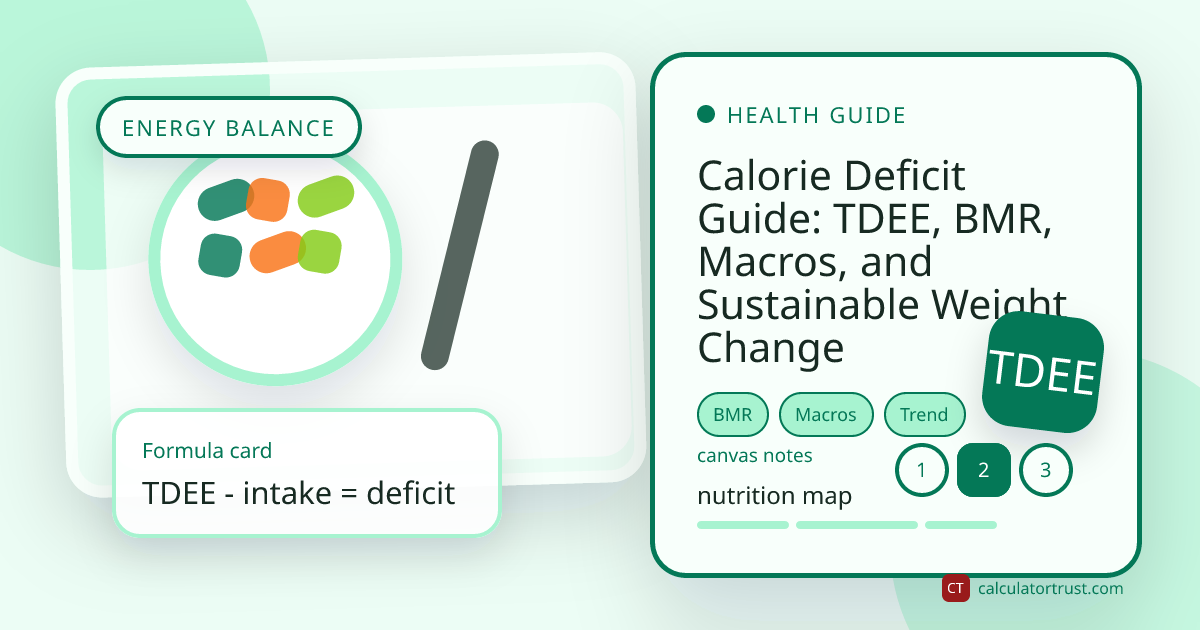
Calorie Deficit Guide: TDEE, BMR, Macros, and Sustainable Weight Change
Learn how calorie deficit math works, how BMR and TDEE are estimated, why activity level matters, and how to use calorie calculators safely and realistically.
Read Article
BMI Chart: Ranges, Limits, and Calculator
Understand your BMI with our comprehensive chart for men and women. Learn BMI ranges, how age and gender factor in, the limitations of BMI, and better alternatives.
Read ArticleWritten and reviewed by Calculator Trust Editorial Team
Our calculators are built using verified formulas from academic, government, and scientific sources. Content is fact-checked and reviewed for accuracy.Note: This calculator provides estimates for educational purposes only. Consult a qualified healthcare professional for personalized advice.