BMI Chart: Ranges, Limits, and Calculator
Understand your BMI with our comprehensive chart for men and women. Learn BMI ranges, how age and gender factor in, the limitations of BMI, and better alternatives.
Body Mass Index, or BMI, is one of the most widely used screening tools in medicine for assessing whether a person is at a healthy weight relative to their height. While it has significant limitations that every health-conscious person should understand, BMI remains a useful starting point for conversations about weight and health. This guide covers everything you need to know about BMI: how to calculate it, what the ranges mean, how to read a BMI chart, and when to look beyond BMI for a more complete health picture.
What Is BMI and How Is It Calculated?
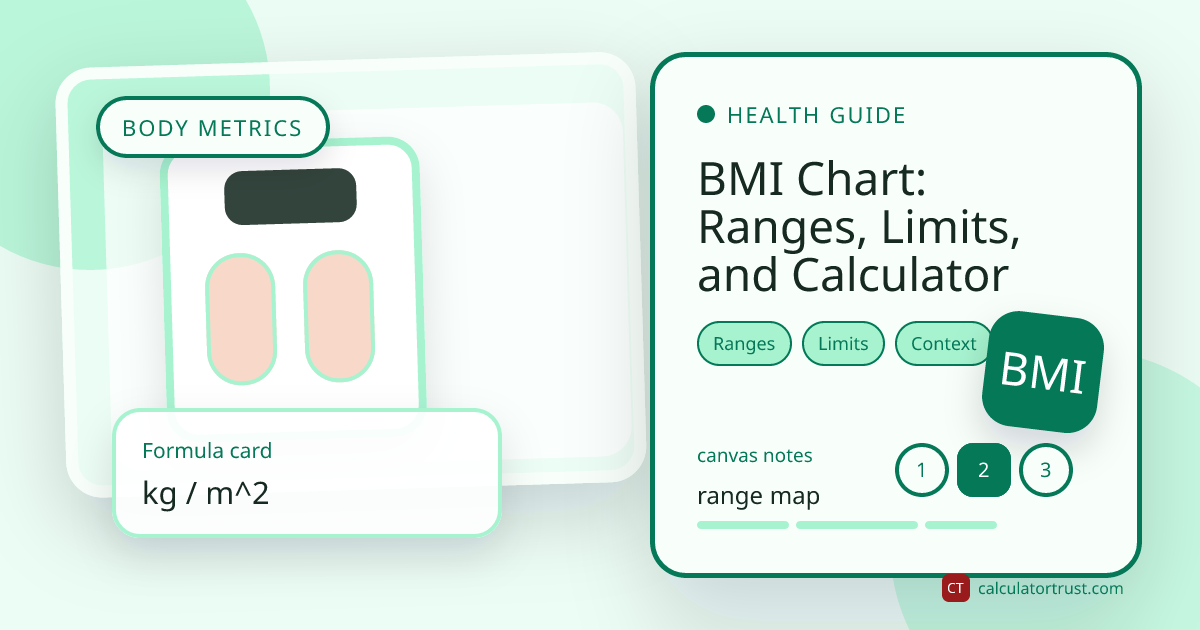
BMI is a simple ratio of weight to height. The formula was developed by Belgian mathematician Adolphe Quetelet in the 1830s and was adopted as a health screening tool in the 20th century. The calculation is straightforward:
BMI = Weight (kg) / Height (m)^2
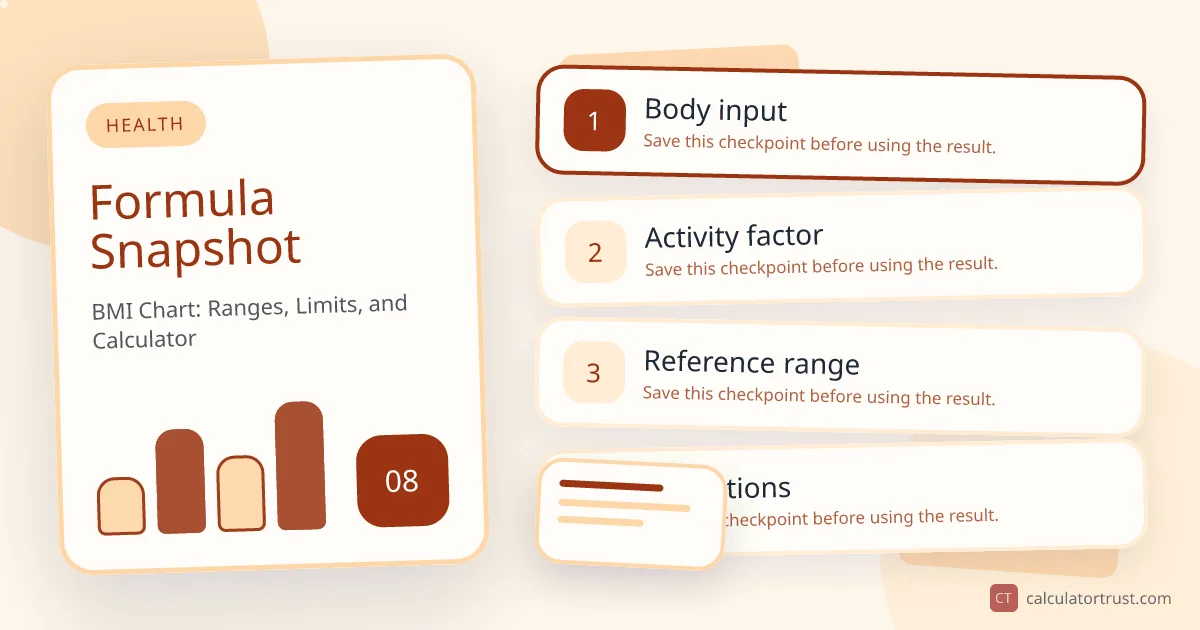
Formula Snapshot
The core equation and the variables that control the answer.
For imperial measurements, the formula is:
BMI = (Weight (lbs) x 703) / Height (inches)^2
For example, a person who weighs 70 kg and is 1.75 m tall has a BMI of 70 / (1.75 x 1.75) = 70 / 3.0625 = 22.9. In imperial units, a person weighing 154 lbs at 5'9" (69 inches) has a BMI of (154 x 703) / (69 x 69) = 108,262 / 4,761 = 22.7. Our BMI calculator handles this math instantly for any measurement system.
Use BMI as a screening tool
BMI is useful for a quick population-style screen, but it should be paired with context such as waist measurement, health history, body composition, and clinical review.
Input Checklist
The values to collect before trusting the calculation.
Standard BMI Ranges for Adults
The World Health Organization (WHO) classifies adult BMI into the following categories:
- Underweight: BMI below 18.5
- Normal weight: BMI 18.5 to 24.9
- Overweight: BMI 25.0 to 29.9
- Obese Class I: BMI 30.0 to 34.9
- Obese Class II: BMI 35.0 to 39.9
- Obese Class III: BMI 40.0 and above
Worked Example Flow
A step-by-step flow for checking the math against real numbers.
These ranges apply to adults aged 20 and older, regardless of sex. They were derived from population-level data correlating BMI with health outcomes such as cardiovascular disease, type 2 diabetes, and overall mortality.
Reading a BMI Chart
A BMI chart is a visual grid that allows you to find your BMI by locating your height on one axis and your weight on the other. The intersection falls into a color-coded zone representing your BMI category. These charts are commonly found in doctor's offices, gyms, and health education materials.
Real-World Scenario
How the calculation changes when real-life assumptions are included.
To use a standard BMI chart, find your height along the left side of the chart, then move across horizontally until you reach your weight. The number at the intersection is your approximate BMI, and the color or zone tells you which category you fall into — typically green for normal, yellow for overweight, and red for obese.
While charts are convenient, they provide approximate values. For a precise calculation, use the formula or an online BMI calculator.
BMI Considerations by Age and Gender
Although the standard BMI formula does not differentiate between men and women, body composition differs between sexes. Women typically have 10-15% more body fat than men at the same BMI. This means a woman with a BMI of 24 may have a body fat percentage of around 30%, while a man with the same BMI might be at 20%. Both fall within the "normal" BMI range, but the health implications of their body composition may differ.
Comparison Map
A visual way to compare options, ranges, or outcomes.
Age also plays a role. As people age, they tend to lose muscle mass and gain fat, even if their weight remains stable. An older adult with a BMI of 23 may carry significantly more body fat than a younger person with the same BMI. Some researchers have suggested that slightly higher BMI ranges (up to 27) may be acceptable or even protective for adults over 65, as mild extra weight can provide reserves during illness.
For children and adolescents, BMI is interpreted using age- and sex-specific percentile charts from the CDC or WHO. A child's BMI is compared to other children of the same age and sex, with the 5th to 85th percentile considered normal weight, the 85th to 95th percentile considered overweight, and above the 95th percentile considered obese.
Limitations of BMI
Despite its widespread use, BMI has well-documented limitations that you should be aware of when interpreting your result:
Mistake Checklist
Common errors that can make a correct formula produce a misleading result.
- It does not measure body fat directly. BMI is a proxy measurement based solely on height and weight. Two people with identical BMIs can have vastly different amounts of body fat and muscle.
- It misclassifies muscular individuals. Athletes, bodybuilders, and people with high muscle mass are often categorized as overweight or obese by BMI despite having low body fat percentages and excellent health markers.
- It does not account for fat distribution. Where you carry fat matters significantly for health risk. Visceral fat (around internal organs) is far more dangerous than subcutaneous fat (under the skin), and BMI cannot distinguish between the two.
- Ethnic and racial differences are not reflected. Research has shown that health risks associated with specific BMI values vary across ethnic groups. For example, people of Asian descent may face increased health risks at lower BMI values than the standard thresholds suggest, while some Pacific Islander populations may have lower risk at higher BMIs.
- It can give a false sense of security or false alarm. A "normal" BMI does not guarantee good metabolic health, and an "overweight" BMI does not necessarily mean poor health, particularly if fitness levels are high.
Alternatives to BMI
Given its limitations, health professionals increasingly use additional measurements alongside BMI to get a more complete picture:
Quality Check
Simple checks for spotting a result that looks too high, low, or incomplete.
- Waist-to-hip ratio (WHR): Measure your waist at the narrowest point and your hips at the widest. Divide waist by hip measurement. A WHR above 0.85 for women or 0.90 for men indicates higher cardiovascular risk. This metric specifically captures central fat distribution.
- Waist circumference: Measured alone, waist circumference is a strong predictor of health risk. A waist circumference over 35 inches (88 cm) for women or 40 inches (102 cm) for men is associated with increased risk of type 2 diabetes, heart disease, and metabolic syndrome.
- Body fat percentage: This directly measures the proportion of fat in your body. Methods include DEXA scans (the gold standard), bioelectrical impedance analysis (BIA), skinfold calipers, and hydrostatic weighing. Healthy body fat ranges are typically 14-24% for men and 21-31% for women.
- Waist-to-height ratio: Your waist circumference should ideally be less than half your height. This simple metric has shown strong correlation with health risk in large population studies.
When to Talk to a Doctor About Your BMI
While BMI is a useful initial screening tool, it should be interpreted within the broader context of your overall health. You should consider talking to a healthcare provider if:
- Your BMI is below 18.5, as underweight status can indicate nutritional deficiencies, eating disorders, or underlying health conditions.
- Your BMI is above 30, as this correlates with increased risk for numerous health conditions including heart disease, type 2 diabetes, certain cancers, and sleep apnea.
- Your BMI has changed significantly in a short period without an obvious explanation.
- You have a family history of obesity-related conditions regardless of your current BMI.
Quick Reference
A compact checklist for using the guide and calculator together.
A doctor can order more detailed assessments such as blood work, body fat measurements, and cardiovascular tests to determine your actual health status rather than relying on BMI alone.
Making Sense of Your BMI
BMI is best thought of as one data point among many, not a definitive health verdict. It is most useful at the population level for tracking trends and identifying groups at higher risk. At the individual level, it should be combined with other measurements, lifestyle factors, family history, and clinical assessments. If you are curious about your BMI, our free BMI calculator provides instant results along with context about what your number means. Remember that a single number cannot fully capture the complexity of your health — use BMI as a starting point for understanding your body, not as the final word.