Biology Calculator
Heart Rate Zone Calculator
Calculate your maximum heart rate and five training zones using the Karvonen formula.
Enter Values
Calculator loading
The guide, formula, examples, and FAQ are available below.
How to Use This Calculator
Enter Age (years)
Type your age (years) into the input field. For example: e.g., 30. Minimum value: 10. Maximum value: 100.
Enter Resting Heart Rate (bpm)
Type your resting heart rate (bpm) into the input field. For example: e.g., 65. Minimum value: 30. Maximum value: 120.
View Your Result
The result appears beside the calculator with the main answer and a detailed calculation breakdown.
Adjust and Explore
Change any input value and calculate again. Use the copy and share controls to save or send your result.
On this page
- Formula
- Methodology
- Examples
- Guide
- The Five Heart Rate Training Zones
- How to Measure Resting Heart Rate
- Zone 2 Training: Why It Gets So Much Attention
- Heart Rate Monitors: Chest Straps vs. Wrist Sensors
- How Fitness Level Affects Your Heart Rate Zones
- Common Training Mistakes Related to Heart Rate
- Heart Rate and Health: What Your Numbers Tell You
- FAQ
Formula
The Karvonen formula calculates target heart rate using heart rate reserve (max HR minus resting HR). This method is more personalized than using a simple percentage of max HR because it accounts for individual fitness levels via resting heart rate.
Calculation methodology
This calculator uses the formula shown on the page and checks common edge cases before returning a result.
Examples and FAQs are included to explain assumptions, limitations, and practical use cases.
Source and review references
Last reviewed by the Calculator Trust Editorial Team. To report an issue, email contact [at] calculatortrust.com.
Common Examples
Understanding the Concept
Training in the right heart rate zone is essential for maximizing the effectiveness of your workouts. Whether your goal is fat burning, endurance building, or peak performance, understanding your heart rate zones helps you train smarter. This calculator uses the Karvonen formula, which accounts for both your age and resting heart rate to produce personalized training zones.
The Five Heart Rate Training Zones
Each heart rate zone corresponds to a different training intensity and physiological benefit:
- Zone 1 (50-60% HRR) - Recovery: Very light effort. Used for warm-ups, cool-downs, and active recovery between hard sessions.
- Zone 2 (60-70% HRR) - Aerobic: Comfortable pace you can sustain for long periods. Builds aerobic base and improves fat metabolism.
- Zone 3 (70-80% HRR) - Tempo: Moderately hard effort. Improves aerobic capacity and muscular endurance.
- Zone 4 (80-90% HRR) - Threshold: Hard effort near lactate threshold. Increases speed and performance at race pace.
- Zone 5 (90-100% HRR) - Max Effort: All-out intensity. Develops maximum speed and power. Only sustainable for short intervals.
How to Measure Resting Heart Rate
For the most accurate resting heart rate measurement, follow these steps:
- Measure your heart rate first thing in the morning, before getting out of bed.
- Place two fingers on the inside of your wrist or on your neck beside the windpipe.
- Count the beats for 60 seconds, or count for 15 seconds and multiply by four.
- Repeat over several mornings and take the average for the most reliable number.
A typical resting heart rate for adults is 60 to 100 bpm. Well-trained athletes may have resting rates as low as 40 bpm. A lower resting heart rate generally indicates better cardiovascular fitness.
Zone 2 Training: Why It Gets So Much Attention
Zone 2 training has become one of the most discussed topics in exercise science and longevity research. Popularized by endurance coaches and health researchers like Dr. Peter Attia, Zone 2 refers to the intensity level where your body primarily burns fat for fuel and your muscles rely on mitochondrial (aerobic) energy production.
Physiologically, Zone 2 is defined as the highest intensity at which your body can still clear lactate as fast as it produces it. You can typically talk in full sentences at this pace, though it feels like moderate effort -- not quite easy, but definitely sustainable for 45 minutes or longer. For a 35-year-old with a resting heart rate of 60, Zone 2 falls roughly between 135 and 148 bpm.
The benefits of consistent Zone 2 training are extensive. It increases the number and efficiency of mitochondria in your muscle cells, improves your body's ability to metabolize fat at rest and during exercise, lowers resting heart rate over time, improves insulin sensitivity, and builds the aerobic base that supports all higher-intensity training. Elite endurance athletes typically spend 70-80% of their training time in Zone 2.
For general health and longevity, most exercise physiologists now recommend 3-4 sessions of 45-60 minutes of Zone 2 training per week. This is a significant shift from the high-intensity interval training (HIIT) craze of the 2010s, which, while effective, can lead to overtraining if done too frequently without an aerobic base.
Heart Rate Monitors: Chest Straps vs. Wrist Sensors
Accurate heart rate monitoring during exercise requires reliable equipment. The two main options are chest strap monitors and optical wrist sensors, and they differ significantly in accuracy and convenience:
Chest strap monitors (like Polar H10 or Garmin HRM-Pro) use electrical signals from your heart to detect each beat, the same principle as a medical ECG. They are accurate to within 1-2 bpm and respond instantly to changes in intensity. The downside is comfort -- some people find the strap annoying, especially during long sessions, and it can shift during certain movements.
Optical wrist sensors (built into smartwatches like Apple Watch, Garmin, and Fitbit) use LED lights to detect blood flow changes in your wrist. They are convenient and require no extra equipment, but accuracy can suffer during activities with a lot of wrist movement, such as weightlifting, rowing, or HIIT circuits. Studies published in the Journal of Sports Sciences found that wrist-based sensors can be off by 5-15 bpm during vigorous, irregular-motion exercise, though they perform well during steady-state activities like running and cycling.
For zone-based training where accuracy matters -- especially distinguishing Zone 2 from Zone 3 -- a chest strap is the better choice. For general fitness tracking and casual monitoring, a wrist-based sensor is perfectly adequate. Some athletes use both: a chest strap during dedicated training sessions and their watch for daily activity tracking and resting heart rate trends.
How Fitness Level Affects Your Heart Rate Zones
Your heart rate zones are not static -- they shift as your fitness improves. Two changes happen simultaneously as you get fitter:
Your resting heart rate decreases. A sedentary adult might have a resting heart rate of 75-80 bpm. After six months of consistent aerobic training, that same person might see their resting rate drop to 58-65 bpm. Since the Karvonen formula uses resting heart rate to calculate heart rate reserve, a lower resting rate expands your usable range and changes your zone boundaries.
Your output at each zone increases. A beginner might reach Zone 3 heart rate while jogging at 6 mph. Six months later, they might need to run 7.5 mph to reach the same heart rate. This is the practical manifestation of improved cardiovascular fitness -- your heart pumps more blood per beat (higher stroke volume), so it does not need to beat as fast at any given workload.
Because of these shifts, recalculating your zones every 8-12 weeks is a good practice if you are training consistently. Track your resting heart rate weekly (most fitness watches automate this) and update the calculator accordingly. If your resting heart rate drops from 70 to 58 over several months, your Zone 2 ceiling might shift upward by 7-8 bpm, allowing you to train at a slightly higher intensity while still getting the aerobic benefits.
Elite athletes also use lab testing (VO2 max tests or lactate threshold tests) to set zones more precisely than any formula can. These tests cost $100-$300 at most sports medicine clinics and provide the gold standard for zone calibration.
Common Training Mistakes Related to Heart Rate
Knowing your zones is only useful if you apply them correctly. Here are the most common mistakes people make with heart rate-based training:
- Training too hard on easy days: This is by far the most common mistake. Many recreational runners and cyclists push into Zone 3 or 4 on days that should be Zone 2 recovery sessions. This accumulates fatigue without providing the aerobic base benefits of true Zone 2 training, and it leaves you too tired to push hard enough on dedicated high-intensity days.
- Ignoring external factors: Heat, humidity, caffeine, stress, sleep quality, and dehydration all elevate heart rate independent of exercise intensity. On a hot day, your Zone 2 pace might feel much harder than usual, and that is normal. Adjust your pace to stay in the target zone rather than forcing your usual speed.
- Obsessing over every beat: Heart rate naturally fluctuates, especially at the start of a workout. Allow 5-10 minutes for your heart rate to stabilize before making pace adjustments. Brief spikes from hills or wind gusts are normal and do not mean you have "left" your zone.
- Using someone else's zones: Two 35-year-olds with different fitness levels will have very different zone boundaries. Always use your own resting heart rate in the Karvonen formula rather than relying on generic age-based charts.
- Neglecting Zone 4 and 5 entirely: While Zone 2 gets the most attention, 1-2 sessions per week of Zone 4-5 intervals are important for improving VO2 max, lactate tolerance, and race-specific fitness. A complete training program includes work across all zones, with Zone 2 as the foundation.
Heart Rate and Health: What Your Numbers Tell You
Beyond exercise training, heart rate data provides valuable insights into your overall cardiovascular health:
Resting heart rate trends: A gradually declining resting heart rate over weeks and months is one of the most reliable indicators that your cardiovascular fitness is improving. Conversely, a sudden increase of 5-10 bpm above your baseline can signal overtraining, illness, or excessive stress. Many athletes use morning resting heart rate as an early warning system -- if it is elevated, they scale back training intensity that day.
Heart rate recovery: How quickly your heart rate drops after stopping intense exercise is a strong predictor of cardiovascular health. A healthy recovery is a drop of at least 12 bpm within the first minute after peak effort. Drops less than 12 bpm have been associated with increased cardiovascular risk in multiple studies. Elite athletes often see drops of 30-50 bpm in the first minute.
Heart rate variability (HRV): This measures the variation in time between successive heartbeats. Higher HRV generally indicates better autonomic nervous system function and greater stress resilience. Many wearable devices now track HRV during sleep. Trends matter more than absolute numbers -- a declining HRV trend over several days suggests accumulated stress or insufficient recovery.
While these metrics are useful self-monitoring tools, they are not substitutes for medical evaluation. If you notice persistent heart rate irregularities, unusual palpitations, or chest discomfort during exercise, consult a healthcare provider. An electrocardiogram (ECG) or stress test can identify issues that heart rate monitoring alone cannot detect.
Frequently Asked Questions
What is the Karvonen formula?
Is the 220 minus age formula accurate?
Which zone is best for fat burning?
How often should I recalculate my heart rate zones?
Why does my heart rate seem high compared to my running partner?
Can medications affect my heart rate zones?
What is a dangerously high heart rate during exercise?
Does heart rate zone training work for strength training?
What is heart rate drift and should I worry about it?
Learn More
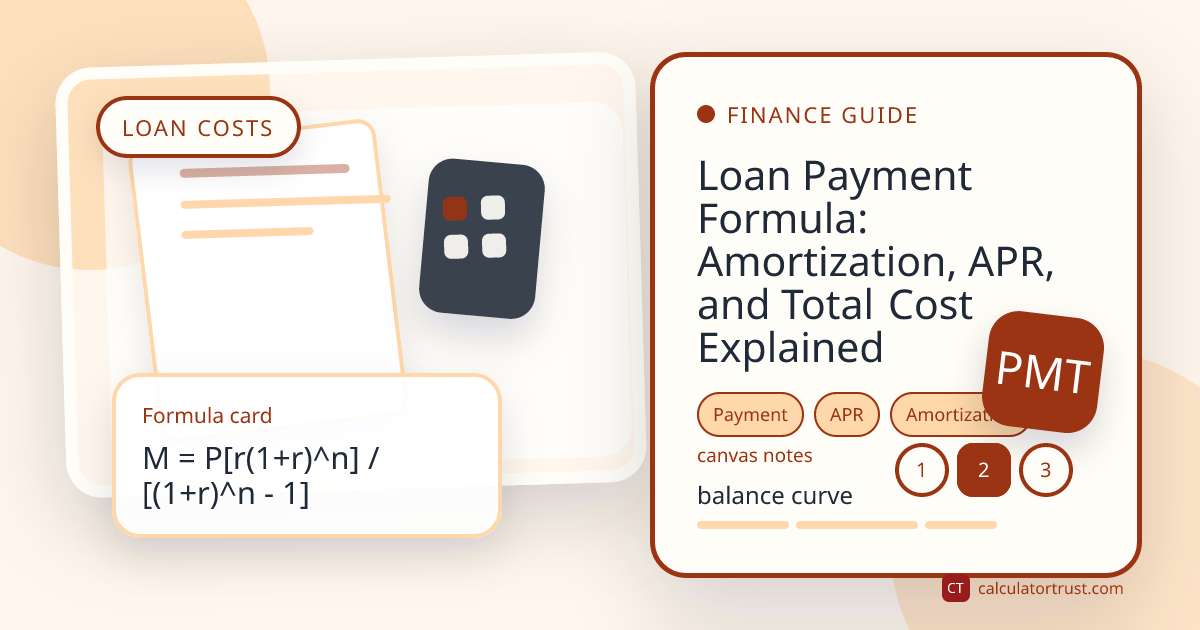
Loan Payment Formula: Amortization, APR, and Total Cost Explained
Learn how loan payments are calculated, how amortization changes principal and interest over time, and how APR, term length, and extra payments affect total cost.
Read Article
Mortgage Affordability Guide: Payment, DTI, Down Payment, and Taxes
A practical guide to estimating mortgage affordability with principal, interest, taxes, insurance, down payment, debt-to-income ratio, and cash reserves.
Read ArticleWritten and reviewed by Calculator Trust Editorial Team
Our calculators are built using verified formulas from academic, government, and scientific sources. Content is fact-checked and reviewed for accuracy.