Everyday Life Calculator
Tip Calculator
Calculate tips quickly. Enter your bill amount, tip percentage, and number of people to split between.
Enter Values
Calculator loading
The guide, formula, examples, and FAQ are available below.
How to Use This Calculator
Enter Bill Amount ($)
Type your bill amount ($) into the input field. For example: e.g., 50.00. Minimum value: 0.
Enter Tip Percentage (%)
Type your tip percentage (%) into the input field. For example: e.g., 18. Minimum value: 0. Maximum value: 100.
Enter Number of People
Type your number of people into the input field. For example: e.g., 2. Minimum value: 1.
View Your Result
The result appears beside the calculator with the main answer and a detailed calculation breakdown.
Adjust and Explore
Change any input value and calculate again. Use the copy and share controls to save or send your result.
On this page
Formula
Multiply the bill by the tip percentage to find the tip amount, add it to the bill for the total, then divide by the number of people.
Calculation methodology
This calculator uses the formula shown on the page and checks common edge cases before returning a result.
Examples and FAQs are included to explain assumptions, limitations, and practical use cases.
Source and review references
Last reviewed by the Calculator Trust Editorial Team. To report an issue, email contact [at] calculatortrust.com.
Common Examples
Understanding the Concept
Tipping is an important part of dining culture in many countries. Whether you are eating out at a restaurant, ordering delivery, or visiting a salon, knowing how much to tip can save awkward moments. This calculator makes it simple to figure out the tip amount, the total bill, and how much each person owes when splitting the check.
How to Calculate a Tip
Calculating a tip is straightforward once you know the formula. Simply multiply your bill amount by the desired tip percentage expressed as a decimal.
- Take your total bill amount before tax (or after, depending on your preference).
- Multiply by the tip percentage divided by 100. For example, 18% becomes 0.18.
- Add the result to your original bill for the total.
- If splitting, divide the total by the number of people.
For a $50 bill with an 18% tip: $50 x 0.18 = $9.00 tip, for a total of $59.00.
Standard Tipping Guidelines
Tipping customs vary by country and service type. In the United States, common guidelines include:
- Restaurants: 15% to 20% is standard for sit-down dining. Exceptional service may warrant 25% or more.
- Delivery: 10% to 15% of the order total, with a minimum of $3 to $5.
- Hair salons and spas: 15% to 20% of the service cost.
- Bars: $1 to $2 per drink, or 15% to 20% of the tab.
When traveling internationally, research local tipping customs as they differ significantly. In some countries, tipping is not expected or is even considered rude.
Quick Mental Math Tricks for Tipping
You do not always need a calculator to figure out a tip. These mental shortcuts work for the most common percentages:
10% tip: Move the decimal point one place to the left. A $67.40 bill has a 10% tip of $6.74. This is your building block for every other calculation.
15% tip: Calculate 10%, then add half of that amount. For $67.40: 10% = $6.74, half of that is $3.37, so 15% = $10.11.
20% tip: Calculate 10% and double it. For $67.40: 10% = $6.74, doubled is $13.48. This is the fastest and most popular mental math method.
25% tip: Calculate 10%, double it for 20%, then add another half of 10%. Or simply divide the bill by 4. For $67.40: $67.40 / 4 = $16.85.
Many people round the bill up to a convenient number before calculating. On a $67.40 bill, round to $70 and calculate 20%: $14.00. The slight rounding makes the math trivial and the difference is just a few cents. For splitting among friends, rounding up also avoids the awkwardness of collecting exact change from everyone.
History of Tipping in America
Tipping in the United States has a complicated and often surprising history. The practice originated in Tudor-era England, where guests at private homes would give small sums to the host's servants. The word "tip" may derive from the acronym "To Insure Promptitude," though etymologists debate this origin. What is certain is that wealthy Americans adopted the practice after traveling to Europe in the late 1800s, bringing it back as a marker of sophistication.
Tipping was initially controversial. In 1904, the Anti-Tipping Society of America formed, with over 100,000 members who viewed tipping as undemocratic and un-American. Several states actually passed anti-tipping laws between 1909 and 1926, though none were enforced for long. The practice took permanent root during Prohibition, when restaurant owners lost alcohol revenue and began relying on tips to subsidize server wages.
Today, tipped workers in many U.S. states earn a federal minimum of just $2.13 per hour in direct wages, with tips expected to bring total compensation above the standard minimum wage. This system has made tipping essentially mandatory for table-service restaurants, which is why 15-20% has become the social norm. Several states, including California, Washington, and Minnesota, require full minimum wage for tipped workers regardless of tips received, leading to slightly different tipping dynamics in those regions.
Tipping Around the World
If you travel internationally, tipping customs can vary dramatically from what you are used to at home. Getting it wrong can be awkward or even offensive in some cultures:
- Japan: Tipping is generally not practiced and can be considered rude. Excellent service is seen as the baseline standard, not something that requires extra payment. If you leave money on the table, staff may chase after you to return it.
- France and Italy: A service charge (service compris) is typically included in the bill. Leaving a small additional amount (1-2 euros) for exceptional service is appreciated but not expected.
- United Kingdom: Tipping 10-15% at restaurants is common, though not as obligatory as in the U.S. Many restaurants add an optional service charge of 12.5%. Tipping in pubs for drinks is uncommon.
- Australia: Tipping is not expected because servers earn a relatively high minimum wage (over $23 AUD per hour). Rounding up the bill or leaving 10% for outstanding service is appreciated but entirely optional.
- Mexico: Tipping 10-15% at restaurants is customary. In tourist areas, 15-20% is increasingly common. Always check whether a service charge (propina) has already been added to the bill.
- Middle East: Practices vary by country. In the UAE, a 10% service charge is often included, but leaving an additional 10% in cash is common. In Egypt, tipping (baksheesh) is expected in most service interactions, including restaurants, hotels, and even for small favors.
When and How Much to Tip for Different Services
Restaurant servers are not the only people who rely on tips. Here is a broader guide for tipping in various situations you might encounter:
- Hotel housekeeping: $2-$5 per night, left daily with a note so the right person receives it. Housekeepers rotate shifts, so leaving a lump sum at checkout may go to the wrong person.
- Hotel bellhop: $1-$2 per bag, or $5 minimum if they make a special effort.
- Taxi and rideshare drivers: 15-20% of the fare for taxis. For rideshare services like Uber and Lyft, $2-$5 or 15-20% for longer rides.
- Food delivery (apps): $3-$5 minimum, or 15-20% for larger orders. Consider tipping more during bad weather or for deliveries that require climbing stairs.
- Movers: $20-$50 per mover for a standard local move. For long, complex moves, $50-$100 per mover is appropriate.
- Tattoo artists: 15-20% of the total cost. For a $500 tattoo session, a $75-$100 tip is typical.
- Valet parking: $2-$5 when your car is returned. Tip when picking up, not when dropping off.
A helpful general rule: if someone provides you a personalized service and you are unsure whether to tip, 15-20% is a safe and appreciated amount in the United States.
Frequently Asked Questions
Should I tip before or after tax?
What is a good tip percentage?
How do I split a tip between multiple people?
Should I tip on takeout and pickup orders?
Is it rude to tip with coins?
What should I do if the service was terrible?
Should I tip more at expensive restaurants?
How do I handle tipping on discounted or comped meals?
What is the difference between a tip and a service charge?
Learn More
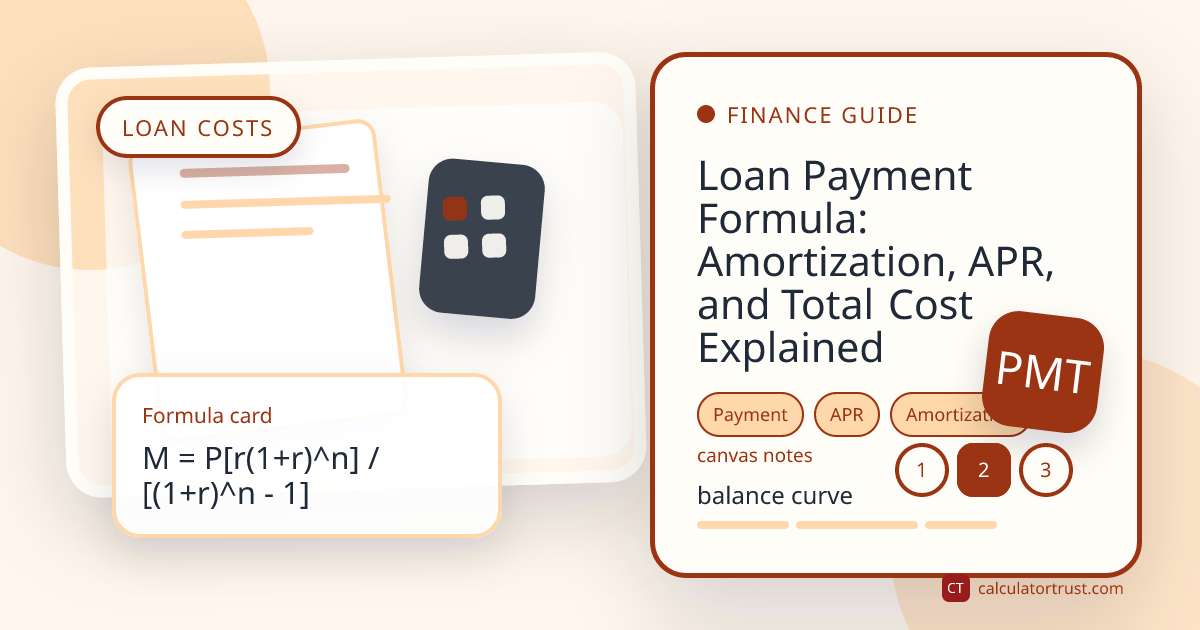
Loan Payment Formula: Amortization, APR, and Total Cost Explained
Learn how loan payments are calculated, how amortization changes principal and interest over time, and how APR, term length, and extra payments affect total cost.
Read Article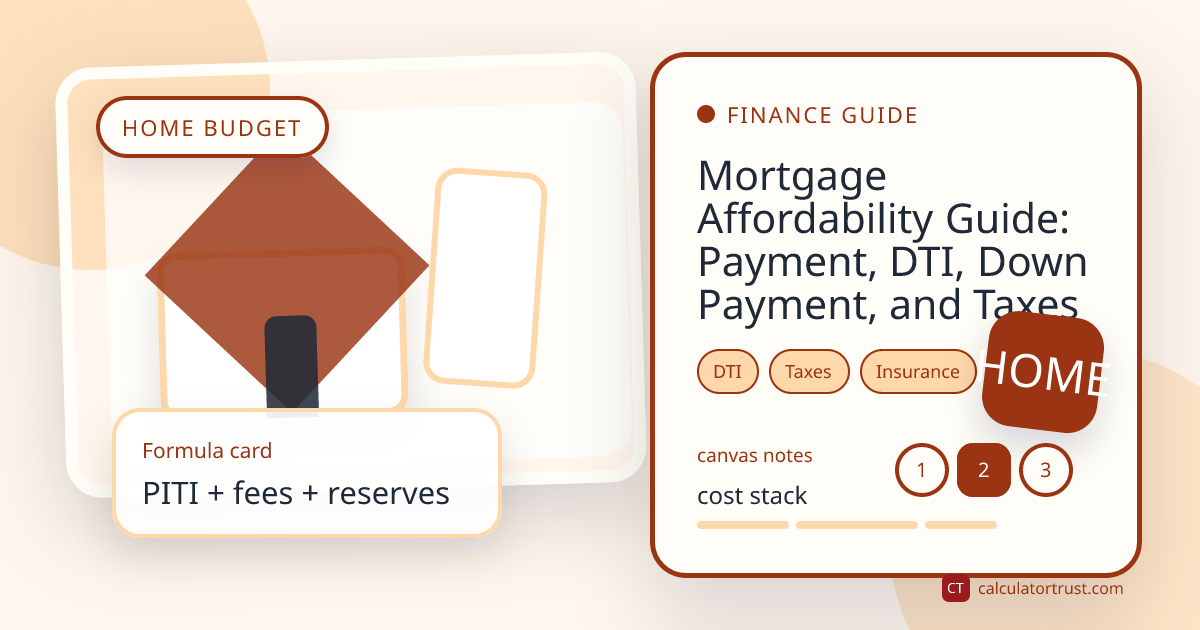
Mortgage Affordability Guide: Payment, DTI, Down Payment, and Taxes
A practical guide to estimating mortgage affordability with principal, interest, taxes, insurance, down payment, debt-to-income ratio, and cash reserves.
Read ArticleWritten and reviewed by Calculator Trust Editorial Team
Our calculators are built using verified formulas from academic, government, and scientific sources. Content is fact-checked and reviewed for accuracy.