Finance Calculator
Loan Payment Calculator
Calculate your monthly loan payment, total interest, and amortization breakdown for any loan amount, interest rate, and term.
Financial estimate notice
Finance calculator results are educational estimates and are not financial advice. Verify rates, fees, taxes, and assumptions with a qualified professional.
Enter Values
Calculator loading
The guide, formula, examples, and FAQ are available below.
How to Use This Calculator
Enter Loan Amount ($)
Type your loan amount ($) into the input field. For example: e.g., 250000. Minimum value: 0.
Enter Annual Interest Rate (%)
Type your annual interest rate (%) into the input field. For example: e.g., 6.5. Minimum value: 0. Maximum value: 100.
Enter Loan Term (years)
Type your loan term (years) into the input field. For example: e.g., 30. Minimum value: 1. Maximum value: 50.
View Your Result
The result appears beside the calculator with the main answer and a detailed calculation breakdown.
Adjust and Explore
Change any input value and calculate again. Use the copy and share controls to save or send your result.
On this page
Formula
Where M is the monthly payment, P is the principal loan amount, r is the monthly interest rate (annual rate divided by 12), and n is the total number of monthly payments (years multiplied by 12).
Finance calculation note
Finance calculators use standard time-value-of-money and amortization formulas for education and planning.
Rates, fees, taxes, inflation, and investment returns can change. Verify assumptions before making financial decisions.
Source and review references
Last reviewed by the Calculator Trust Editorial Team. To report an issue, email contact [at] calculatortrust.com.
Common Examples
Understanding the Concept
Understanding your monthly loan payment is one of the most important steps in personal finance planning. Whether you are buying a home, financing a car, or taking out a personal loan, knowing exactly how much you will owe each month helps you budget effectively and avoid financial stress. This loan payment calculator uses the standard amortization formula to give you an accurate monthly payment amount, along with the total interest you will pay over the life of the loan.
How Loan Payments Are Calculated
Loan payments are calculated using an amortization formula that ensures each monthly payment covers both the interest owed for that period and a portion of the principal balance. The formula is M = P[r(1+r)^n] / [(1+r)^n - 1], where P is the principal, r is the monthly interest rate, and n is the number of payments.
In the early years of a loan, a larger portion of each payment goes toward interest. As the principal decreases over time, more of each payment is applied to the principal. This is why making extra payments early in a loan term can save significant amounts of interest.
Factors That Affect Your Monthly Payment
Three main factors determine the size of your monthly loan payment:
- Loan Amount (Principal): The total amount you borrow. A larger principal means higher monthly payments.
- Interest Rate: The annual percentage rate charged by the lender. Even a small change in interest rate can significantly affect your total cost. For example, on a $250,000 30-year mortgage, the difference between 6% and 7% adds about $166 per month and over $59,000 in total interest.
- Loan Term: The length of the repayment period. Longer terms mean lower monthly payments but more total interest paid. A 15-year mortgage has higher monthly payments than a 30-year mortgage but costs far less in total interest.
Tips for Reducing Your Loan Costs
There are several strategies to minimize the total cost of borrowing:
- Make extra payments: Even small additional payments toward the principal each month can shave years off your loan and save thousands in interest.
- Choose a shorter term: If you can afford higher monthly payments, a shorter loan term dramatically reduces total interest paid.
- Refinance when rates drop: If interest rates fall significantly below your current rate, refinancing can lower your monthly payment or total interest.
- Improve your credit score: A higher credit score qualifies you for lower interest rates, which directly reduces your monthly payment and total cost.
Fixed-Rate vs. Adjustable-Rate Loans
Fixed-rate loans keep the same interest rate throughout the entire loan term, giving you predictable monthly payments. This calculator assumes a fixed rate. Adjustable-rate mortgages (ARMs) start with a lower introductory rate that later adjusts periodically based on market conditions, which can cause payments to increase or decrease over time.
Fixed-rate loans are generally recommended for borrowers who plan to stay in their home long-term and prefer payment stability. ARMs may benefit borrowers who plan to sell or refinance within the initial fixed-rate period.
Frequently Asked Questions
How is the monthly loan payment calculated?
Does a longer loan term mean I pay more overall?
What is included in a mortgage payment besides principal and interest?
How much of my payment goes to interest vs. principal?
Can I use this calculator for car loans or personal loans?
Learn More
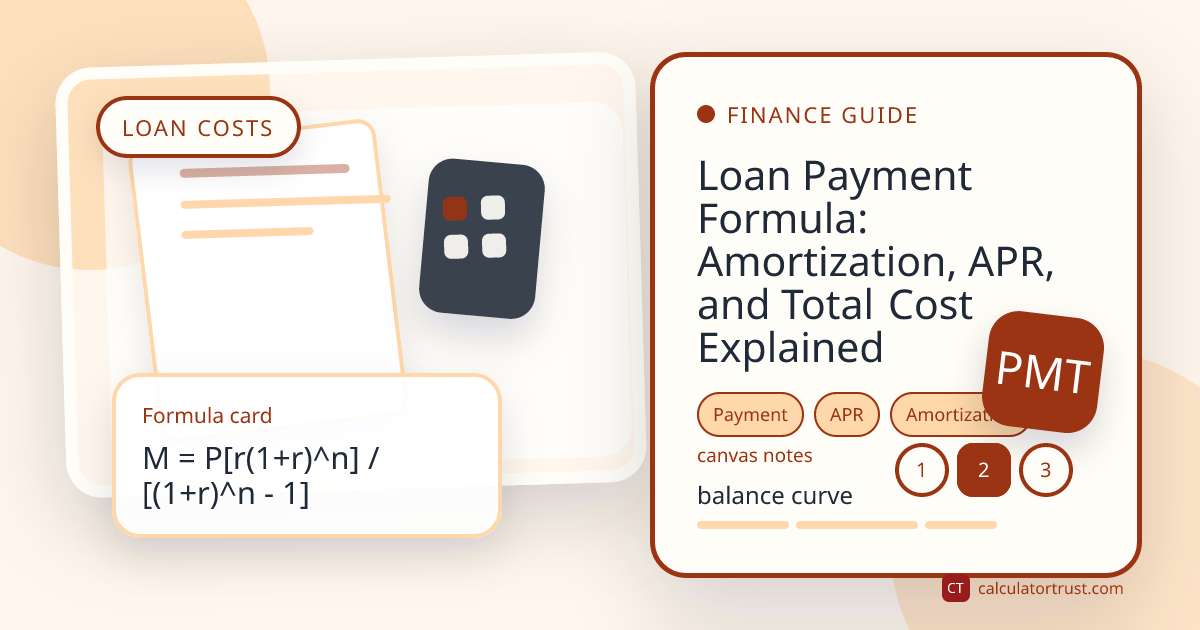
Loan Payment Formula: Amortization, APR, and Total Cost Explained
Learn how loan payments are calculated, how amortization changes principal and interest over time, and how APR, term length, and extra payments affect total cost.
Read Article
Mortgage Affordability Guide: Payment, DTI, Down Payment, and Taxes
A practical guide to estimating mortgage affordability with principal, interest, taxes, insurance, down payment, debt-to-income ratio, and cash reserves.
Read ArticleWritten and reviewed by Calculator Trust Editorial Team
Our calculators are built using verified formulas from academic, government, and scientific sources. Content is fact-checked and reviewed for accuracy.Note: This calculator provides estimates for educational purposes only. Consult a qualified financial advisor for personalized advice.