Finance Calculator
Sales Tax Calculator
Calculate sales tax, total price, and effective cost per dollar. Enter your price and tax rate for instant results.
Financial estimate notice
Finance calculator results are educational estimates and are not financial advice. Verify rates, fees, taxes, and assumptions with a qualified professional.
Enter Values
Calculator loading
The guide, formula, examples, and FAQ are available below.
How to Use This Calculator
Enter Price Before Tax ($)
Type your price before tax ($) into the input field. For example: e.g., 100.00. Minimum value: 0.
Enter Tax Rate (%)
Type your tax rate (%) into the input field. For example: e.g., 8.25. Minimum value: 0. Maximum value: 100.
View Your Result
The result appears beside the calculator with the main answer and a detailed calculation breakdown.
Adjust and Explore
Change any input value and calculate again. Use the copy and share controls to save or send your result.
On this page
Formula
Sales tax is calculated by multiplying the pre-tax price by the tax rate expressed as a decimal. The total price is the sum of the original price and the tax amount. The effective cost per dollar shows how much you actually pay for every dollar of pre-tax value.
Finance calculation note
Finance calculators use standard time-value-of-money and amortization formulas for education and planning.
Rates, fees, taxes, inflation, and investment returns can change. Verify assumptions before making financial decisions.
Source and review references
Last reviewed by the Calculator Trust Editorial Team. To report an issue, email contact [at] calculatortrust.com.
Common Examples
Understanding the Concept
Sales tax adds a percentage to the price of goods and services at the point of purchase. In the United States, sales tax rates vary by state, county, and city, making it essential to know the exact rate for your location. This calculator helps you determine the tax amount, total cost, and how much each dollar of your purchase really costs after tax is applied.
How Sales Tax Works
Sales tax is a consumption tax imposed by state and local governments on the sale of goods and, in some cases, services. Key points to understand:
- Sales tax is calculated as a percentage of the pre-tax price.
- The seller collects the tax at the point of sale and remits it to the government.
- Rates vary widely: some states have no sales tax (Oregon, Montana, New Hampshire, Delaware, Alaska), while others exceed 10% when state and local rates are combined.
- Some items may be exempt from sales tax, such as groceries, prescription medications, and clothing in certain states.
State Sales Tax Rates
Sales tax rates in the United States range from 0% to over 10% when combined with local taxes. Some notable examples:
- No sales tax: Alaska, Delaware, Montana, New Hampshire, Oregon
- Low rates (4-5%): Colorado (2.9%), Alabama (4%), Hawaii (4%)
- Moderate rates (6-7%): Pennsylvania (6%), Texas (6.25%), New York (4% state + local)
- High rates (7%+): California (7.25% state), Tennessee (7%), Indiana (7%)
Remember that local jurisdictions often add additional taxes on top of the state rate, so your effective rate may be higher than the state base rate.
Sales Tax vs. Value-Added Tax (VAT)
The US sales tax system differs from the value-added tax (VAT) used in most other countries:
- Sales tax is applied only at the final point of sale to the consumer. The listed price typically does not include tax.
- VAT is applied at each stage of production and distribution. In most countries, the listed price already includes VAT.
- This is why prices in the US appear lower on the shelf but increase at checkout, while prices in Europe already include all taxes.
How to Calculate Reverse Sales Tax (Finding the Pre-Tax Price)
Sometimes you know the total amount paid and need to figure out the original price before tax. This is called a reverse sales tax calculation, and it comes up often when reviewing receipts, splitting costs, or doing bookkeeping.
The formula is straightforward: divide the total price by (1 + the tax rate as a decimal). For example, if you paid $108.25 total and the tax rate was 8.25%:
- Convert the tax rate to a decimal: 8.25% = 0.0825
- Add 1: 1 + 0.0825 = 1.0825
- Divide the total by this number: $108.25 / 1.0825 = $100.00
- The tax amount was: $108.25 - $100.00 = $8.25
This reverse calculation is particularly useful for business owners who need to separate tax collected from revenue earned, or for anyone who wants to verify that a retailer charged the correct tax rate. If you divide a receipt total by the expected multiplier and the result does not match the listed subtotal, the merchant may have applied the wrong rate.
The Real Cost of Sales Tax on Big Purchases
Sales tax is easy to overlook on small purchases, but it adds up significantly on expensive items. Understanding the true impact helps you budget more accurately for major expenses:
- New car ($35,000): At an 8% combined rate, sales tax adds $2,800 to the price. In states like California with high local rates reaching 10.25% in some cities, that same car costs an extra $3,587.50 in tax.
- Furniture set ($5,000): At 7% tax, you pay an additional $350. Many people forget to include this when budgeting for a home renovation or move.
- Electronics ($1,200 laptop): Even at a moderate 6% rate, tax adds $72. Ordering from a retailer in a no-tax state used to save this amount, but post-2018 rules have largely eliminated that strategy.
- Annual household spending: The average American household spends roughly $60,000 per year on taxable goods and services. At an average combined rate of 7%, that is about $4,200 per year in sales tax, or $350 per month.
Some states offer partial relief on large purchases. For instance, several states cap the sales tax on vehicle purchases or provide a reduced rate on manufacturing equipment. Checking your state's specific rules before a major purchase can save hundreds or even thousands of dollars.
Sales Tax Holidays and How to Save
Many states hold annual sales tax holidays — designated weekends or weeks when certain categories of purchases are exempt from sales tax. These events are designed to encourage spending and provide relief to consumers, particularly families preparing for the school year.
Common types of sales tax holidays include:
- Back-to-school holidays (most common): Typically held in late July or August. States like Texas, Florida, and Ohio exempt clothing, school supplies, and sometimes computers below certain price thresholds. Texas exempts clothing and footwear under $100 and school supplies under $100 per item.
- Hurricane/disaster preparedness holidays: States like Florida and Virginia offer tax-free weekends on batteries, flashlights, generators, and emergency supplies, usually in late spring before hurricane season.
- Energy-efficient appliance holidays: A few states periodically exempt Energy Star-rated appliances to encourage energy conservation. Savings on a $1,200 refrigerator at an 8% rate would be $96.
To maximize savings, plan major purchases around these events. A family buying $500 in school clothes and supplies during a tax holiday in a state with an 8% rate saves $40 — enough to cover a month of school lunches. Check your state's department of revenue website for specific dates and eligible items, as rules vary significantly between states.
Sales Tax for Business Owners
If you run a business that sells taxable goods or services, understanding sales tax obligations is critical. Getting it wrong can result in penalties, interest charges, and even fraud allegations. Here are the key points every business owner should know:
- Nexus determines where you must collect tax: You must collect sales tax in any state where you have "nexus" — a significant business presence. This used to mean a physical location, but since the 2018 Wayfair ruling, selling more than $100,000 per year (in most states) to residents of a state creates "economic nexus" even without a physical presence.
- You must remit collected tax on schedule: Depending on your sales volume, you may need to file sales tax returns monthly, quarterly, or annually. Missing deadlines results in penalties typically ranging from 5% to 25% of the unpaid tax.
- Resale certificates matter: If you purchase goods for resale, you can avoid paying sales tax on those purchases by providing your supplier with a valid resale certificate. You then collect and remit the tax when you sell to the end consumer.
- Keep meticulous records: Retain all sales records, tax returns, and exemption certificates for at least three to four years (longer in some states). Auditors can request documentation going back several years.
For businesses selling in multiple states, the compliance burden can be significant. Many small businesses use automated sales tax software like TaxJar, Avalara, or the built-in tools in platforms like Shopify and Square to calculate the correct rate for each transaction based on the buyer's location.
Frequently Asked Questions
How do I calculate sales tax?
Which states have no sales tax?
Is sales tax included in the listed price?
Do I have to pay sales tax on online purchases?
What items are exempt from sales tax?
How do I find my exact local sales tax rate?
Is there sales tax on food and groceries?
Do I pay sales tax on used or secondhand items?
What is use tax and how does it differ from sales tax?
Learn More
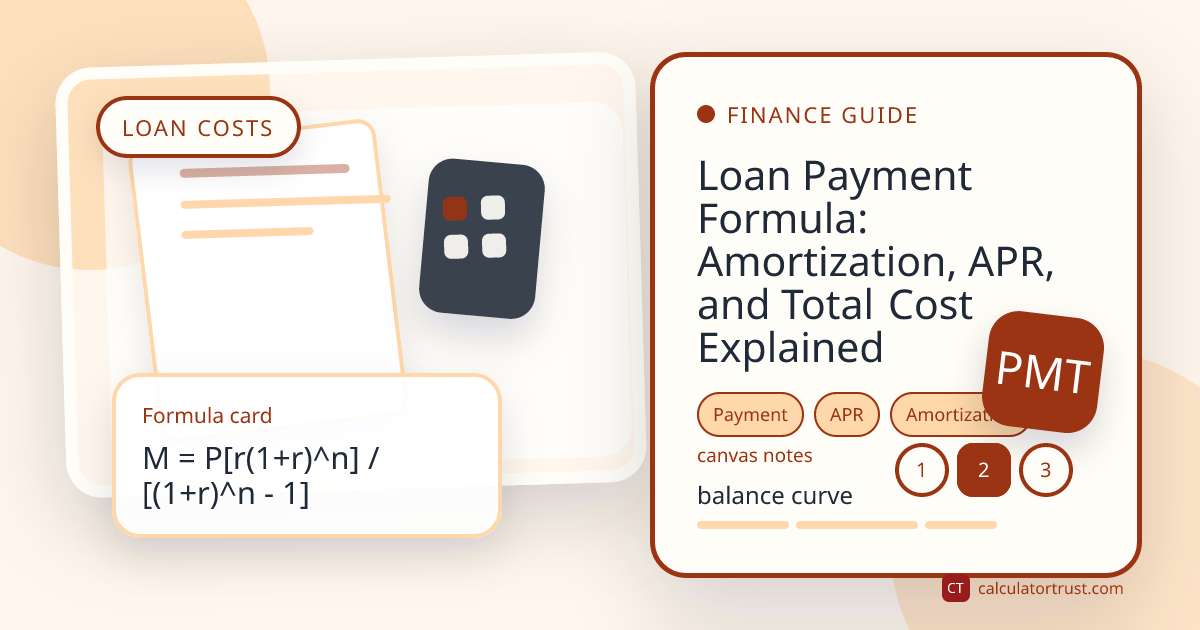
Loan Payment Formula: Amortization, APR, and Total Cost Explained
Learn how loan payments are calculated, how amortization changes principal and interest over time, and how APR, term length, and extra payments affect total cost.
Read Article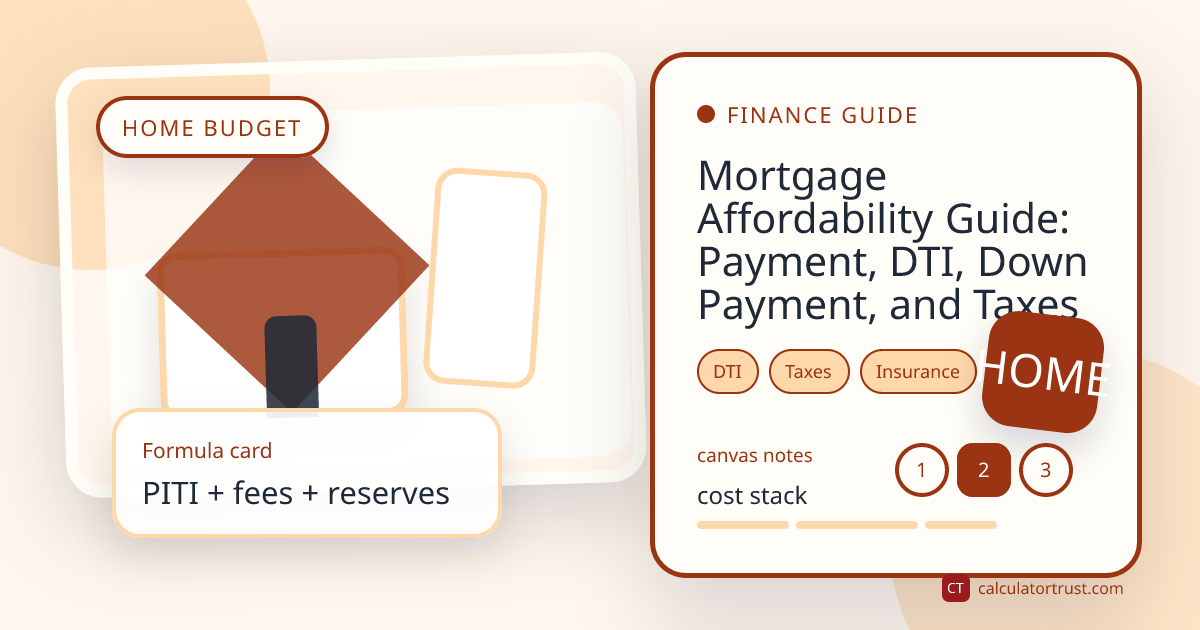
Mortgage Affordability Guide: Payment, DTI, Down Payment, and Taxes
A practical guide to estimating mortgage affordability with principal, interest, taxes, insurance, down payment, debt-to-income ratio, and cash reserves.
Read ArticleWritten and reviewed by Calculator Trust Editorial Team
Our calculators are built using verified formulas from academic, government, and scientific sources. Content is fact-checked and reviewed for accuracy.Note: This calculator provides estimates for educational purposes only. Consult a qualified financial advisor for personalized advice.