Food & Nutrition Calculator
Recipe Scaler Calculator
Scale recipe ingredients up or down based on the number of servings you need.
Enter Values
Calculator loading
The guide, formula, examples, and FAQ are available below.
How to Use This Calculator
Enter Original Servings
Type your original servings into the input field. For example: e.g., 4. Minimum value: 1.
Enter Desired Servings
Type your desired servings into the input field. For example: e.g., 8. Minimum value: 1.
Enter Ingredient Amount
Type your ingredient amount into the input field. For example: e.g., 2. Minimum value: 0.
View Your Result
The result appears beside the calculator with the main answer and a detailed calculation breakdown.
Adjust and Explore
Change any input value and calculate again. Use the copy and share controls to save or send your result.
On this page
Formula
Divide the desired servings by the original servings to get a scale factor, then multiply each ingredient amount by that factor.
Calculation methodology
This calculator uses the formula shown on the page and checks common edge cases before returning a result.
Examples and FAQs are included to explain assumptions, limitations, and practical use cases.
Source and review references
Last reviewed by the Calculator Trust Editorial Team. To report an issue, email contact [at] calculatortrust.com.
Common Examples
Understanding the Concept
Cooking for more or fewer people than a recipe calls for? This recipe scaler helps you adjust ingredient quantities proportionally. Whether you are doubling a recipe for a dinner party or halving it for a quiet meal at home, accurate scaling ensures your dish turns out just right every time.
How to Scale a Recipe
Scaling a recipe is a matter of simple multiplication. The key is finding the right scale factor and applying it consistently to every ingredient.
- Determine the original number of servings the recipe makes.
- Decide how many servings you actually need.
- Divide the desired servings by the original to get the scale factor.
- Multiply each ingredient by the scale factor.
For example, if a recipe serves 4 and you need 10 servings, your scale factor is 10/4 = 2.5. An ingredient listed as 1 cup becomes 2.5 cups.
Tips for Successful Scaling
While scaling ingredients is mathematically simple, a few practical tips can help you get better results:
- Spices and seasonings: Scale these conservatively. If doubling a recipe, start with 1.5x the seasoning and adjust to taste.
- Baking recipes: Baking is more sensitive to proportions. Large scaling factors (3x or more) may require adjustments to leavening agents and baking times.
- Cooking times: Larger batches may need longer cooking times, while smaller batches may cook faster. Monitor temperature rather than relying solely on time.
- Pan sizes: When scaling up, you may need larger or additional pans to avoid overcrowding, which affects cooking quality.
Common Mistakes When Scaling Recipes
Even experienced home cooks stumble when scaling recipes. Here are the pitfalls to watch out for:
Over-scaling leavening agents: Baking powder and baking soda do not scale linearly at large multiples. If a recipe calls for 1 teaspoon of baking powder for a batch of 12 muffins and you want 48, using 4 teaspoons can create a bitter, metallic taste and cause the batter to rise too fast and collapse. A safer approach is to scale leavening to about 75-80% of the mathematical amount for anything beyond a 2x increase.
Ignoring surface-area effects: When you double a soup recipe, the pot surface area does not double. This means evaporation slows relative to volume, and your sauce or soup may end up thinner than expected. Plan to simmer a bit longer or use less liquid (about 75% of the scaled amount) and adjust at the end.
Forgetting about eggs: Eggs are tricky to scale because you cannot easily use half an egg. For recipes that call for 3 eggs and you need 1.5x, that is 4.5 eggs. You can either round to 4 or 5 (4 for denser results, 5 for lighter) or beat an egg and measure out half by volume. One large egg is roughly 3 tablespoons, so half is about 1.5 tablespoons.
Not adjusting salt gradually: Salt perception is not perfectly linear. Doubling the salt in a doubled recipe often tastes saltier than expected, especially in baked goods. Scale salt to about 80% of the mathematical amount and taste-test before committing.
Scaling Baked Goods vs. Stovetop Dishes
Not all recipes behave the same way when scaled, and the biggest divide is between baking and stovetop cooking.
Stovetop dishes like soups, stews, sauces, and stir-fries are forgiving. The chemistry is simpler -- you are mostly managing heat, time, and flavor balance. If you double a chicken soup recipe, the main adjustment is using a larger pot and cooking a few minutes longer. Spices and salt deserve a taste-check halfway through, but the dish will not fail catastrophically if proportions are slightly off.
Baking is chemistry. Flour provides structure, fat provides tenderness, sugar affects moisture and browning, eggs bind everything together, and leavening agents create rise through precise chemical reactions. Doubling a cake recipe usually works fine, but tripling or quadrupling requires attention. At 3x and above, consider mixing the batter in separate standard batches rather than one enormous bowl. This keeps gluten development predictable and ensures leavening agents are evenly distributed.
Oven temperature typically stays the same when scaling baked goods, but baking time increases. A doubled batch of cookies takes the same time per sheet (just more sheets), but a doubled cake in a larger pan needs 15-25% more time in the oven. Always use an instant-read thermometer or the toothpick test rather than relying on time alone.
Measurement Conversions for Scaled Recipes
After scaling, you often end up with awkward measurements. Knowing key conversions helps you translate scaled amounts into something practical:
- 3 teaspoons = 1 tablespoon
- 4 tablespoons = 1/4 cup
- 16 tablespoons = 1 cup
- 2 cups = 1 pint
- 4 cups = 1 quart
- 4 quarts = 1 gallon
- 8 ounces = 1 cup (liquid measure)
For example, if scaling gives you 6 tablespoons of butter, that equals 3/8 cup, which is easier to measure. If you end up with 0.67 cups of milk, that is about 2/3 cup -- roughly 10 tablespoons plus 2 teaspoons. A kitchen scale that measures in grams is often the simplest solution for odd amounts, since 1 cup of flour is approximately 120 grams and you can measure any fraction precisely.
Professional bakers almost exclusively use weight measurements (grams or ounces) instead of volume. If you do a lot of scaling, converting your favorite recipes to weight-based measurements once will make every future scaling calculation simpler and more accurate.
Scaling for Special Diets and Large Events
Scaling recipes for large events like holiday dinners, potlucks, or catering introduces challenges beyond simple math. When cooking for 20 or more people, consider these practical strategies:
Plan for realistic portions: At a buffet with multiple dishes, guests typically eat smaller portions of each item compared to a single-dish meal. If your pasta recipe feeds 4 as a main course, it may serve 8-10 as part of a spread. Adjust your scaling factor accordingly to avoid massive over-production.
Equipment limitations matter: Your home oven can typically handle 2-3 sheet pans at once. If you need 8 sheet pans of roasted vegetables, you will need to cook in batches, which affects timing. Start with dishes that hold well at room temperature or can be reheated, and leave last-minute items for the final oven rotation.
Special diets add complexity: When scaling for groups that include vegetarians, vegans, or people with allergies, it is easier to choose recipes that naturally accommodate restrictions rather than trying to make substitutions at scale. A large vegetable curry scales better than trying to produce a vegan version of beef stew for half the guests and the original for the other half.
The 10% rule: For events with 10 or more guests, prepare about 10% more food than your calculations suggest. This buffer accounts for second helpings, unexpected guests, and the inevitable tasting you will do while cooking.
Frequently Asked Questions
Can I scale any recipe?
How do I handle odd measurements after scaling?
Should I scale cooking time as well?
How do I scale a recipe that calls for eggs?
What is the best way to scale recipes for a crowd of 50?
Do I need to adjust oven temperature when scaling?
How do I halve a recipe that uses 1 egg?
Is it better to use weight or volume when scaling?
Learn More
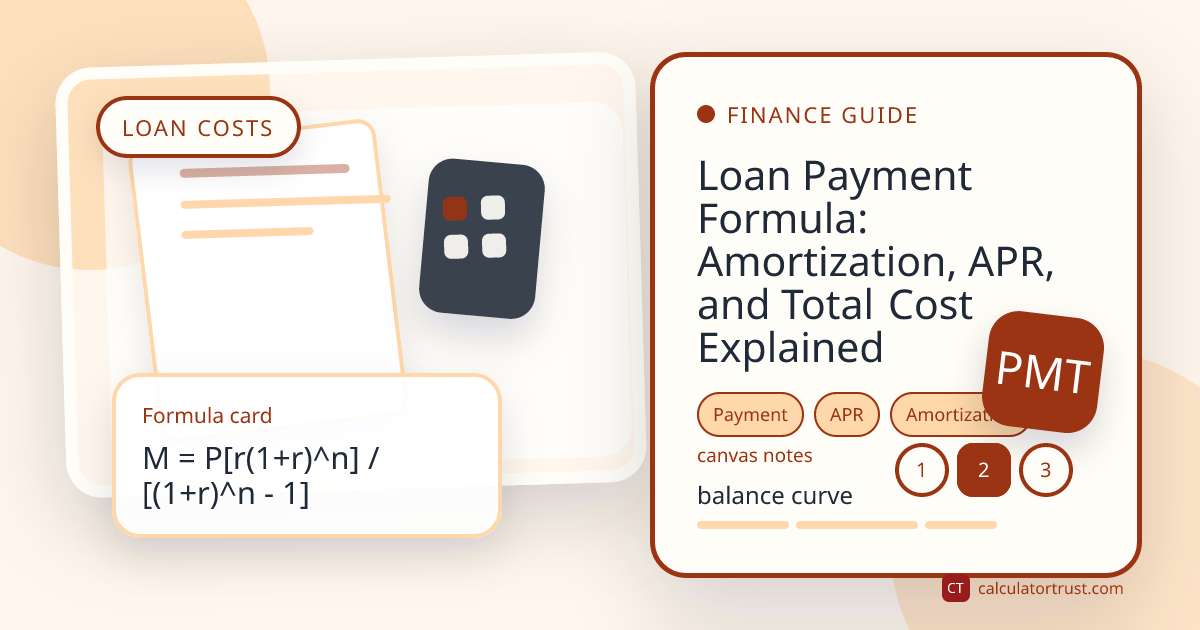
Loan Payment Formula: Amortization, APR, and Total Cost Explained
Learn how loan payments are calculated, how amortization changes principal and interest over time, and how APR, term length, and extra payments affect total cost.
Read Article
Mortgage Affordability Guide: Payment, DTI, Down Payment, and Taxes
A practical guide to estimating mortgage affordability with principal, interest, taxes, insurance, down payment, debt-to-income ratio, and cash reserves.
Read ArticleWritten and reviewed by Calculator Trust Editorial Team
Our calculators are built using verified formulas from academic, government, and scientific sources. Content is fact-checked and reviewed for accuracy.