Health Calculator
BMI Calculator
Calculate your Body Mass Index (BMI) instantly to see if you are at a healthy weight.
Health estimate notice
Health calculator results are educational estimates and are not medical advice. Speak with a qualified healthcare professional before making health decisions.
Enter Values
Calculator loading
The guide, formula, examples, and FAQ are available below.
How to Use This Calculator
Enter Weight (kg)
Type your weight (kg) into the input field. For example: e.g., 70. Minimum value: 1.
Enter Height (cm)
Type your height (cm) into the input field. For example: e.g., 175. Minimum value: 1.
View Your Result
The result appears beside the calculator with the main answer and a detailed calculation breakdown.
Adjust and Explore
Change any input value and calculate again. Use the copy and share controls to save or send your result.
On this page
Formula
Body Mass Index is a simple calculation using a person's height and weight. The formula is BMI = kg/m² where kg is a person's weight in kilograms and m² is their height in metres squared.
Health calculation note
Health calculators provide screening or planning estimates, not medical diagnoses.
Results can vary by age, sex, body composition, medical history, medication, and clinician-specific guidance.
Source and review references
Last reviewed by the Calculator Trust Editorial Team. To report an issue, email contact [at] calculatortrust.com.
Common Examples
Understanding the Concept
Body Mass Index (BMI) is a measure of body fat based on height and weight that applies to adult men and women. While it does not measure body fat directly, it correlates with direct measures of body fat and is an inexpensive and easy-to-perform method of screening for weight categories that may lead to health problems.
BMI Categories
- Underweight: BMI less than 18.5
- Normal weight: BMI 18.5 to 24.9
- Overweight: BMI 25 to 29.9
- Obese: BMI 30 or greater
History and Origin of the BMI Formula
The BMI formula was developed by Belgian mathematician Adolphe Quetelet between 1830 and 1850. Quetelet was not a physician; he was a statistician interested in defining the characteristics of the "average man." His original index, called the Quetelet Index, was designed for population-level studies rather than individual health assessments.
It was not until 1972 that researcher Ancel Keys published a study in the Journal of Chronic Diseases coining the term "Body Mass Index" and recommending its use over other body-fat formulas. Keys explicitly noted that BMI was appropriate for population studies and not for individual diagnosis. Despite this caveat, BMI became widely adopted by insurance companies, public health agencies, and clinical guidelines throughout the 1980s and 1990s because of its simplicity and low cost.
The World Health Organization formally adopted BMI cutoff points in 1995, establishing the categories still used today. Understanding this history helps explain both why BMI is so widespread and why it has well-known limitations when applied to individuals rather than large groups.
Limitations and Common Misconceptions
BMI is a useful screening tool, but it has several important limitations that people frequently misunderstand. The most significant is that BMI cannot distinguish between lean mass and fat mass. A 6-foot rugby player weighing 220 pounds and a sedentary person of the same height and weight will receive identical BMI scores, even though their body compositions are drastically different.
Another common misconception is that a "normal" BMI guarantees good health. Research published in the International Journal of Obesity found that nearly 30% of people with normal BMI scores were metabolically unhealthy, showing elevated blood pressure, high cholesterol, or insulin resistance. Conversely, about 16% of people classified as obese by BMI were metabolically healthy by every clinical marker.
BMI also does not account for age-related changes in body composition. Older adults tend to lose muscle and gain fat even if their weight stays the same, meaning their BMI remains unchanged while their health risk increases. For these reasons, clinicians increasingly use BMI alongside other measurements like waist circumference, body fat percentage, and blood work rather than relying on it alone.
BMI for Children and Adolescents
BMI works differently for children and teenagers than it does for adults. Because body composition changes significantly as children grow, pediatric BMI is expressed as a percentile relative to other children of the same age and sex. A child at the 85th percentile has a higher BMI than 85% of children the same age and sex.
The Centers for Disease Control and Prevention (CDC) uses the following categories for children aged 2 through 19:
- Underweight: Below the 5th percentile
- Healthy weight: 5th to 84th percentile
- Overweight: 85th to 94th percentile
- Obese: 95th percentile or above
Growth charts from the CDC or WHO are essential for interpreting pediatric BMI correctly. A BMI of 22 might be perfectly healthy for a 16-year-old boy but concerning for an 8-year-old. Parents should discuss their child's BMI percentile with a pediatrician rather than comparing raw numbers to adult categories.
Better Alternatives and Complementary Measures
If you want a more complete picture of your health beyond BMI, several complementary measurements are worth considering:
- Waist circumference: Abdominal fat is more strongly linked to heart disease and type 2 diabetes than overall body weight. A waist measurement above 40 inches for men or 35 inches for women signals elevated risk, regardless of BMI.
- Waist-to-hip ratio: Dividing your waist measurement by your hip measurement provides insight into fat distribution. Ratios above 0.90 for men and 0.85 for women indicate increased cardiovascular risk.
- Body fat percentage: Measured via skinfold calipers, bioelectrical impedance, or DEXA scans. Healthy ranges are roughly 10-20% for men and 18-28% for women, though these vary by age.
- Waist-to-height ratio: Simply dividing your waist circumference by your height. A ratio above 0.5 is associated with increased health risks. This metric is gaining popularity because it is just as simple as BMI but accounts for fat distribution.
No single number tells the full story. The best approach combines multiple metrics with regular check-ups and attention to how you feel in daily life.
Real-World Applications of BMI
Despite its limitations, BMI remains widely used across many sectors. Health insurance companies in the United States historically used BMI thresholds to set premiums, though this practice has come under increasing scrutiny. Employers running corporate wellness programs often track average BMI as one indicator of workforce health, sometimes offering incentives to employees who maintain scores in the normal range.
Public health researchers rely on BMI data to track obesity trends across populations and over time. The CDC's National Health and Nutrition Examination Survey (NHANES), for instance, has documented the rise in average American BMI from 25.0 in the 1960s to 29.4 by the early 2020s. This kind of population-level tracking would be impractical with more complex measurements like DEXA scans.
Military organizations around the world also use BMI alongside other fitness tests for recruitment screening. The U.S. Army, for example, requires recruits to fall within specific BMI ranges, though soldiers who exceed the limit can qualify by passing a body-fat-percentage tape test. In clinical settings, BMI serves as a quick triage tool that helps doctors decide which patients need further metabolic screening, even though the final diagnosis always depends on more detailed assessments.
Frequently Asked Questions
Is BMI accurate for athletes?
What is a healthy BMI range for adults?
Does BMI differ by age or gender?
How often should I check my BMI?
Can two people with the same BMI have very different health risks?
Why do some countries use different BMI cutoffs?
Is BMI useful for tracking weight loss progress?
What BMI is considered morbidly obese?
Learn More
Calorie Deficit Guide: TDEE, BMR, Macros, and Sustainable Weight Change
Learn how calorie deficit math works, how BMR and TDEE are estimated, why activity level matters, and how to use calorie calculators safely and realistically.
Read Article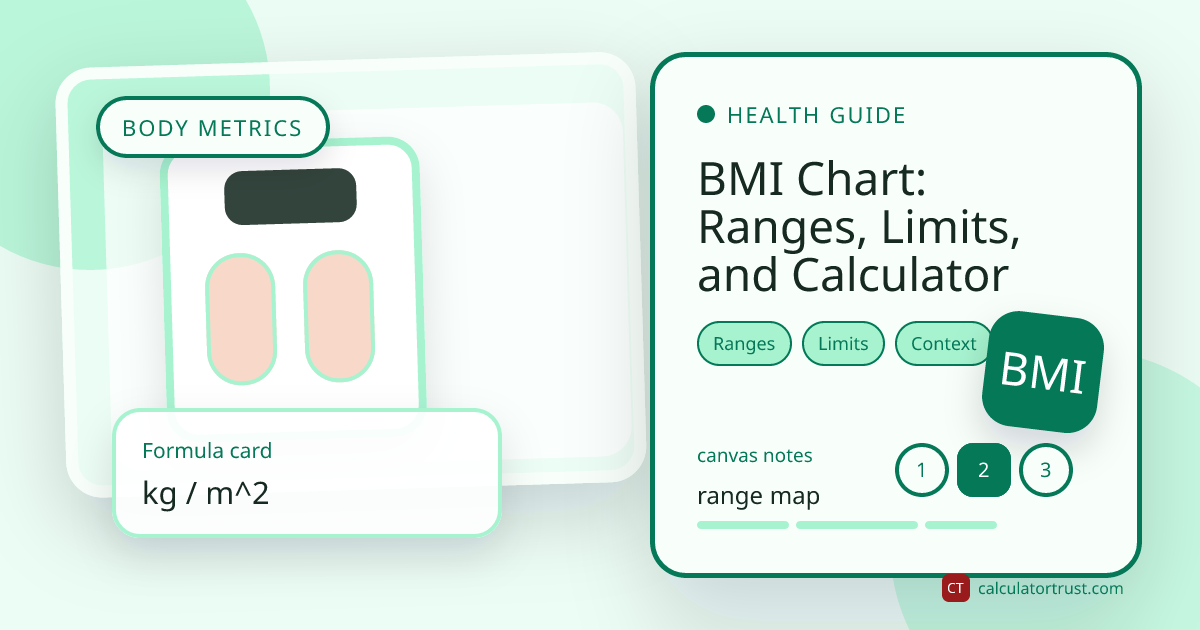
BMI Chart: Ranges, Limits, and Calculator
Understand your BMI with our comprehensive chart for men and women. Learn BMI ranges, how age and gender factor in, the limitations of BMI, and better alternatives.
Read ArticleWritten and reviewed by Calculator Trust Editorial Team
Our calculators are built using verified formulas from academic, government, and scientific sources. Content is fact-checked and reviewed for accuracy.Note: This calculator provides estimates for educational purposes only. Consult a qualified healthcare professional for personalized advice.