Compound Interest Explained: How Your Money Grows Over Time
Understand how compound interest works, the formula behind it, and why Albert Einstein reportedly called it the eighth wonder of the world. Includes examples and the Rule of 72.
Compound interest is one of the most powerful concepts in personal finance. It is the mechanism by which your money earns returns not only on the original amount you invest, but also on all the interest that has previously accumulated. Over long periods, this creates exponential growth that can transform modest savings into substantial wealth. Whether you are saving for retirement, paying off a mortgage, or simply trying to grow your emergency fund, understanding compound interest is essential.
What Is Compound Interest?
At its core, compound interest means earning interest on your interest. When you deposit money into a savings account or investment, the institution pays you interest on your balance. With compound interest, that earned interest gets added to your balance, and the next interest payment is calculated on the new, larger total. This cycle repeats with every compounding period, creating a snowball effect that accelerates your growth over time.
Consider a simple example: You deposit $1,000 at 5% annual interest compounded yearly. After the first year, you earn $50 in interest, bringing your balance to $1,050. In the second year, you earn 5% on $1,050 — that is $52.50 rather than $50. By the third year, you earn $55.13. Each year, the interest earned increases because the base amount keeps growing.
Why time matters more than it looks
The early years can feel slow because the balance is still small. The later years do more work because previous interest has become part of the base.
Formula Snapshot
The core equation and the variables that control the answer.
The Compound Interest Formula
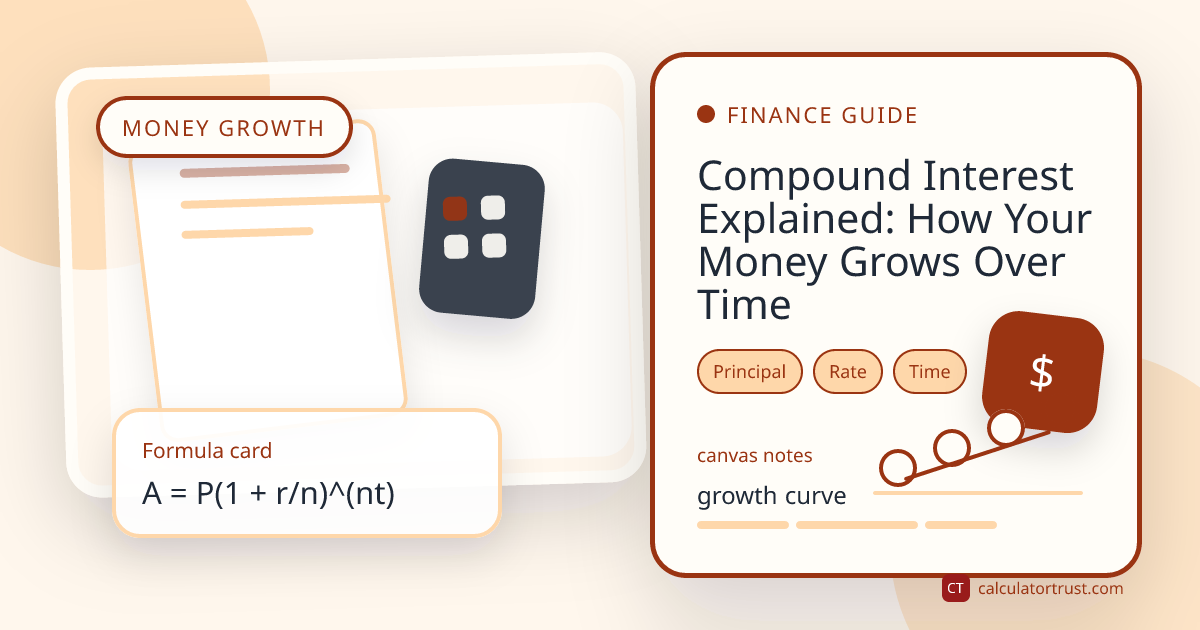
The standard compound interest formula is:
A = P(1 + r/n)^(nt)
Where:
Input Checklist
The values to collect before trusting the calculation.
- A = the future value of the investment or loan, including interest
- P = the principal (initial amount)
- r = the annual interest rate (as a decimal)
- n = the number of times interest compounds per year
- t = the number of years
For example, if you invest $5,000 at a 6% annual rate compounded monthly for 10 years: A = 5000(1 + 0.06/12)^(12 x 10) = 5000(1.005)^120 = 5000 x 1.8194 = $9,097. Your initial $5,000 nearly doubles without any additional contributions. Use our compound interest calculator to run your own scenarios instantly.
Compound Interest vs. Simple Interest
The difference between compound and simple interest becomes dramatic over time. Simple interest is calculated only on the original principal using the formula I = P x r x t. This means you earn the same dollar amount of interest each period.
Worked Example Flow
A step-by-step flow for checking the math against real numbers.
Let us compare $10,000 invested at 8% for 30 years under both methods:
- Simple interest: $10,000 + ($10,000 x 0.08 x 30) = $10,000 + $24,000 = $34,000
- Compound interest (annual): $10,000 x (1.08)^30 = $10,000 x 10.0627 = $100,627
The compound interest scenario yields nearly three times as much. This gap widens further with higher rates and longer time horizons. The extra $66,627 in this example comes entirely from the compounding effect — interest earned on interest.
The Rule of 72: A Quick Estimation Tool
The Rule of 72 is a handy mental shortcut for estimating how long it takes for an investment to double. Simply divide 72 by the annual interest rate:
Real-World Scenario
How the calculation changes when real-life assumptions are included.
Years to Double = 72 / Interest Rate
Here are some common examples:
- At 4% interest: 72 / 4 = 18 years to double
- At 6% interest: 72 / 6 = 12 years to double
- At 8% interest: 72 / 8 = 9 years to double
- At 10% interest: 72 / 10 = 7.2 years to double
- At 12% interest: 72 / 12 = 6 years to double
This rule also works in reverse. If you want your money to double in 5 years, you need a return of approximately 72 / 5 = 14.4% per year. The Rule of 72 is most accurate for rates between 4% and 12%, and it assumes no additional contributions or withdrawals.
Comparison Map
A visual way to compare options, ranges, or outcomes.
How Compounding Frequency Affects Growth
Interest can compound at different intervals: annually, semi-annually, quarterly, monthly, daily, or even continuously. The more frequently interest compounds, the more you earn, though the marginal benefit decreases as frequency increases.
Consider $10,000 at 6% annual interest for 10 years with different compounding frequencies:
- Annually: $10,000 x (1.06)^10 = $17,908
- Semi-annually: $10,000 x (1.03)^20 = $18,061
- Quarterly: $10,000 x (1.015)^40 = $18,140
- Monthly: $10,000 x (1.005)^120 = $18,194
- Daily: $10,000 x (1 + 0.06/365)^3650 = $18,221
The jump from annual to monthly compounding adds $286 over ten years. The jump from monthly to daily adds only $27 more. For most practical purposes, monthly compounding captures the vast majority of the benefit. Savings accounts typically compound daily, while many bonds compound semi-annually.
Mistake Checklist
Common errors that can make a correct formula produce a misleading result.
The Power of Starting Early
Time is the most important ingredient in compound interest. Starting early, even with smaller amounts, can produce better results than starting later with larger contributions.
Consider two investors, both earning 7% annual returns compounded monthly:
- Investor A starts at age 25, contributes $200/month for 10 years (until age 35), then stops contributing but leaves the money invested until age 65. Total contributions: $24,000.
- Investor B starts at age 35, contributes $200/month continuously for 30 years until age 65. Total contributions: $72,000.
Quality Check
Simple checks for spotting a result that looks too high, low, or incomplete.
At age 65, Investor A has approximately $244,000, while Investor B has approximately $243,000. Despite contributing three times less money, Investor A ends up with a slightly larger balance because of those extra 10 years of compounding. This illustrates why financial advisors consistently stress the importance of starting to save and invest as early as possible.
Compound Interest and Debt
The same force that grows your savings works against you when you carry debt. Credit cards, student loans, and mortgages all use compound interest — and when you are the borrower, it means you owe interest on previously accrued interest.
Credit card interest is particularly punishing because it typically compounds daily at high rates. A $3,000 balance at 22% APR compounding daily, with only minimum payments (usually 2% of the balance or $25, whichever is greater), can take over 14 years to pay off and cost over $4,500 in interest alone — more than the original balance.
Understanding compound interest on debt provides strong motivation to pay down high-interest balances aggressively. Every extra dollar you pay toward principal reduces the base on which future interest is calculated, creating a positive compounding effect in your favor.
Quick Reference
A compact checklist for using the guide and calculator together.
Practical Tips for Leveraging Compound Interest
Now that you understand how compound interest works, here are actionable strategies to make it work for you:
- Start investing as early as possible. Even small amounts benefit enormously from additional years of compounding.
- Reinvest your returns. Dividends and interest should be reinvested rather than withdrawn to maximize the compounding effect.
- Increase contributions over time. As your income grows, increase your regular contributions. Even small incremental increases compound significantly over decades.
- Choose accounts with frequent compounding. All else being equal, prefer accounts that compound more frequently.
- Minimize fees. Investment fees reduce your effective return rate. A 1% annual fee might seem small, but over 30 years it can reduce your final balance by over 25% compared to a lower-fee alternative.
- Pay down high-interest debt first. Compound interest working against you through debt is a guaranteed loss, while investment returns are variable.
Compound interest rewards patience, consistency, and early action. Whether you are building wealth for retirement, saving for a major purchase, or planning your children's education fund, the principles remain the same: invest early, reinvest returns, and let time do the heavy lifting. Try our compound interest calculator to model different scenarios and see how your money can grow over time.