How to Calculate Percentage: Complete Guide with Examples
Learn how to calculate percentages with easy formulas and real-world examples. Covers finding a percentage of a number, percentage change, and percentage difference.
Percentages are one of the most commonly used mathematical concepts in daily life. Whether you are calculating a tip at a restaurant, figuring out a sale discount, or analyzing financial data, understanding how to calculate percentages is an essential skill. In this comprehensive guide, we will walk you through every type of percentage calculation you might encounter, complete with formulas and real-world examples.
What Is a Percentage?
A percentage is a way of expressing a number as a fraction of 100. The word itself comes from the Latin per centum, meaning "by the hundred." When you see the symbol %, it simply means "out of 100." For example, 45% means 45 out of every 100, or the fraction 45/100, which equals the decimal 0.45.
Percentages make it easier to compare values on a common scale. Instead of saying "I answered 18 out of 24 questions correctly," you can say "I scored 75%," which is immediately understandable and comparable to other scores.
Quick intuition check
Before calculating, ask whether the answer should be smaller or larger than the original number. This quick estimate catches many percentage-base mistakes.
The Three Types of Percentage Problems
Almost every percentage problem falls into one of three categories. Understanding each type will give you the tools to solve virtually any percentage question you encounter.
Formula Snapshot
The core equation and the variables that control the answer.
Type 1: Finding a Percentage of a Number
This is the most common type. The formula is:
Result = (Percentage / 100) x Number
For example, what is 20% of 350? Using the formula: (20 / 100) x 350 = 0.20 x 350 = 70. So 20% of 350 is 70. You can use our percentage calculator to verify this instantly.
Type 2: Finding What Percentage One Number Is of Another
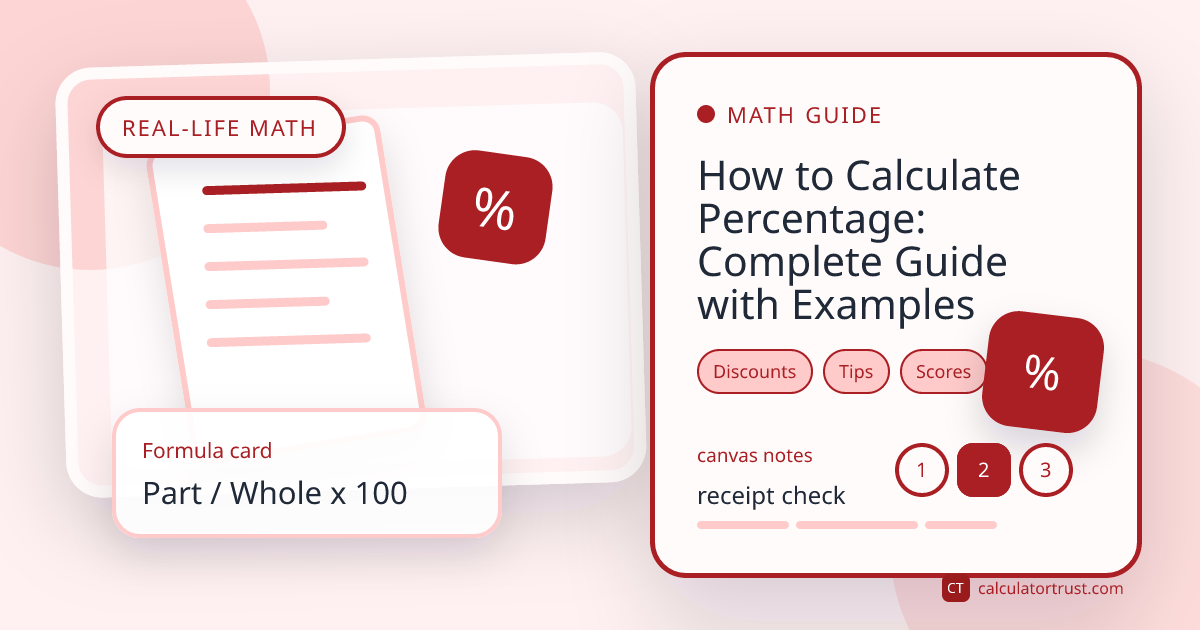
When you know the part and the whole and need to find the percentage, use:
Input Checklist
The values to collect before trusting the calculation.
Percentage = (Part / Whole) x 100
For example, if a student answered 36 out of 40 questions correctly, the percentage score is (36 / 40) x 100 = 90%.
Type 3: Finding the Whole When You Know the Part and Percentage
Sometimes you know a number is a certain percentage of an unknown total. The formula is:
Whole = Part / (Percentage / 100)
Worked Example Flow
A step-by-step flow for checking the math against real numbers.
For example, if 15% of a number is 45, then the whole number is 45 / 0.15 = 300.
Real-World Examples: Shopping Discounts
One of the most common places you will use percentages is when shopping. Understanding how discounts work can save you money and help you make better purchasing decisions.
Example: A jacket originally costs $120 and is on sale for 35% off. How much do you save, and what is the final price?
- Discount amount: (35 / 100) x $120 = $42
- Sale price: $120 - $42 = $78
A shortcut is to calculate the remaining percentage directly. If the discount is 35%, you pay 65% of the original price: 0.65 x $120 = $78. This one-step approach is faster and works well when you need a quick mental calculation.
Real-World Scenario
How the calculation changes when real-life assumptions are included.
What about stacking discounts? If a store offers 20% off, and then you have an additional 10% coupon, the total discount is not 30%. The second discount applies to the already-reduced price. Starting at $100: after 20% off you pay $80, and then 10% off $80 gives you $72. The effective discount is 28%, not 30%.
Calculating Tips at Restaurants
Tipping is another everyday percentage calculation. In the United States, customary tips range from 15% to 20% of the pre-tax bill. Here are some quick methods for calculating tips mentally:
- 10% method: Move the decimal point one place to the left. For a $65.00 bill, 10% is $6.50.
- 15% tip: Find 10%, then add half of that. $6.50 + $3.25 = $9.75.
- 20% tip: Find 10% and double it. $6.50 x 2 = $13.00.
- 18% tip: Find 20% and subtract 10% of the tip. $13.00 - $1.30 = $11.70.
For exact calculations, our percentage calculator makes it simple to enter any tip percentage and get an instant result.
Percentage Change: Increases and Decreases
Percentage change tells you how much a value has grown or shrunk relative to its original value. This is crucial in finance, economics, and data analysis.
Comparison Map
A visual way to compare options, ranges, or outcomes.
Percentage Change = ((New Value - Old Value) / Old Value) x 100
A positive result indicates an increase; a negative result indicates a decrease.
Example: Your monthly electricity bill went from $95 to $114. What is the percentage increase? ((114 - 95) / 95) x 100 = (19 / 95) x 100 = 20%. Your bill increased by 20%.
Example: A stock price dropped from $50 to $42. The percentage change is ((42 - 50) / 50) x 100 = (-8 / 50) x 100 = -16%. The stock declined by 16%.
An important nuance: percentage increases and decreases are not symmetrical. If something increases by 50% (from 100 to 150), it needs to decrease by 33.3% (not 50%) to return to its original value. This asymmetry matters a great deal in investing and financial planning.
Mistake Checklist
Common errors that can make a correct formula produce a misleading result.
Calculating Grades and Test Scores
Students and educators use percentages extensively for grading. Here is how to calculate your grade percentage and what it means.
Grade Percentage = (Points Earned / Total Points) x 100
Suppose your course has the following components: homework worth 30% of the final grade, a midterm worth 30%, and a final exam worth 40%. If you scored 85% on homework, 78% on the midterm, and 92% on the final, your weighted average is:
(0.30 x 85) + (0.30 x 78) + (0.40 x 92) = 25.5 + 23.4 + 36.8 = 85.7%
Weighted averages are a practical application of percentages that help fairly represent the importance of different components.
Quality Check
Simple checks for spotting a result that looks too high, low, or incomplete.
Percentage Difference vs. Percentage Change
While percentage change measures the shift from one specific value to another, percentage difference compares two independent values without either being the reference point.
Percentage Difference = (|Value 1 - Value 2| / ((Value 1 + Value 2) / 2)) x 100
Example: City A has a population of 250,000 and City B has a population of 310,000. The percentage difference is: (|250,000 - 310,000| / ((250,000 + 310,000) / 2)) x 100 = (60,000 / 280,000) x 100 = 21.4%.
Use percentage difference when comparing two values where neither is the clear "original." This is common in scientific studies, benchmarking, and surveys.
Common Percentage Mistakes to Avoid
Even experienced professionals make percentage errors. Here are the most common mistakes and how to avoid them:
Quick Reference
A compact checklist for using the guide and calculator together.
- Confusing percentage points with percentages. If an interest rate goes from 3% to 5%, that is an increase of 2 percentage points, but a 66.7% percentage increase. These are very different statements.
- Applying percentages to the wrong base. A 10% raise followed by a 10% pay cut does not bring you back to your original salary. The cut applies to the higher salary, leaving you slightly below where you started.
- Ignoring compounding effects. When percentages compound over time, the results are not simply additive. A 7% annual return over 10 years does not produce a 70% total return — it produces approximately 96.7% due to compounding.
- Rounding too early. When performing multi-step percentage calculations, keep full decimal precision through intermediate steps and round only at the end to avoid cumulative errors.
Quick Mental Math Tricks for Percentages
You can speed up many percentage calculations with these mental math techniques:
- The flip trick: 8% of 50 equals 50% of 8, which is 4. You can always swap the percentage and the number if it makes the calculation easier.
- Breaking it down: To find 15% of a number, calculate 10% and then add half of that. To find 35%, calculate 25% plus 10%.
- Using fractions: 25% = 1/4, 33.3% = 1/3, 50% = 1/2, 75% = 3/4. If you recognize these equivalents, the math becomes division, which is often simpler.
- Doubling and halving: To find 5%, calculate 10% and divide by 2. To find 40%, calculate 20% and double it.
Mastering percentage calculations is a practical skill that pays dividends in everyday life, from managing finances to evaluating data. With the formulas and techniques covered in this guide, you should be well-equipped to tackle any percentage problem. For quick verification of your work, try our free percentage calculator — it handles all three types of percentage problems instantly and accurately.